Read the story · Download the guide
28. What I Have Receipts For
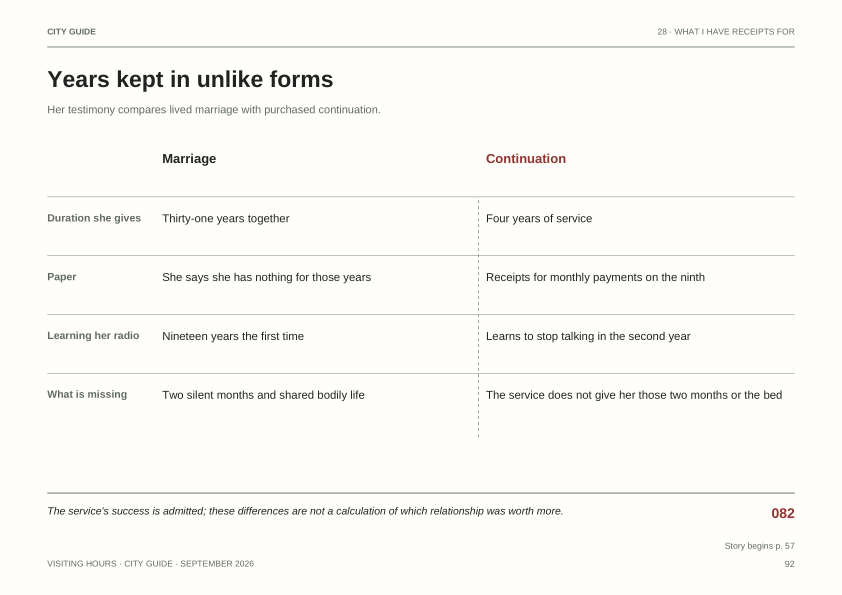
Her testimony compares lived marriage with purchased continuation.
| Marriage | Continuation | |
|---|---|---|
| Duration she gives | Thirty-one years together | Four years of service |
| Paper | She says she has nothing for those years | Receipts for monthly payments on the ninth |
| Learning her radio | Nineteen years the first time | Learns to stop talking in the second year |
| What is missing | Two silent months and shared bodily life | The service does not give her those two months or the bed |
The service's success is admitted; these differences are not a calculation of which relationship was worth more.
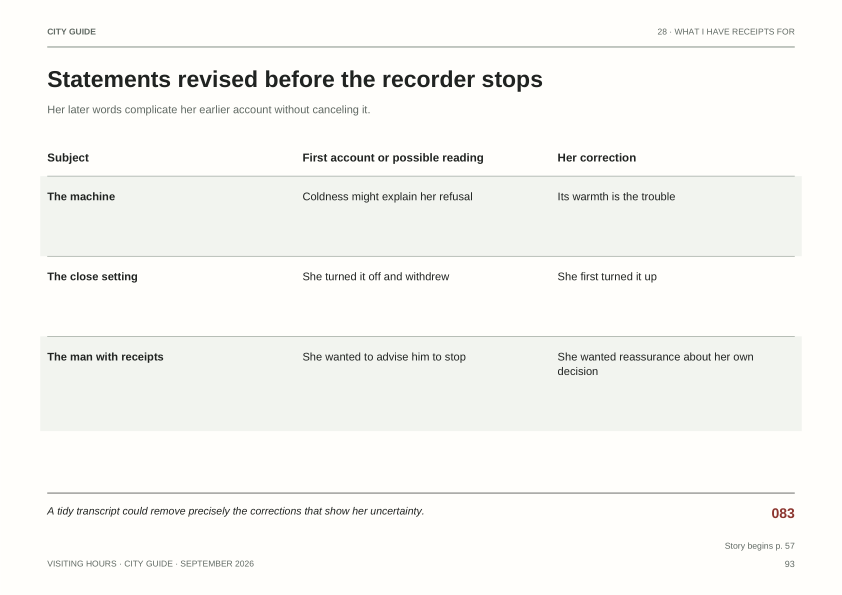
Her later words complicate her earlier account without canceling it.
| Subject | First account or possible reading | Her correction |
|---|---|---|
| The machine | Coldness might explain her refusal | Its warmth is the trouble |
| The close setting | She turned it off and withdrew | She first turned it up |
| The man with receipts | She wanted to advise him to stop | She wanted reassurance about her own decision |
A tidy transcript could remove precisely the corrections that show her uncertainty.
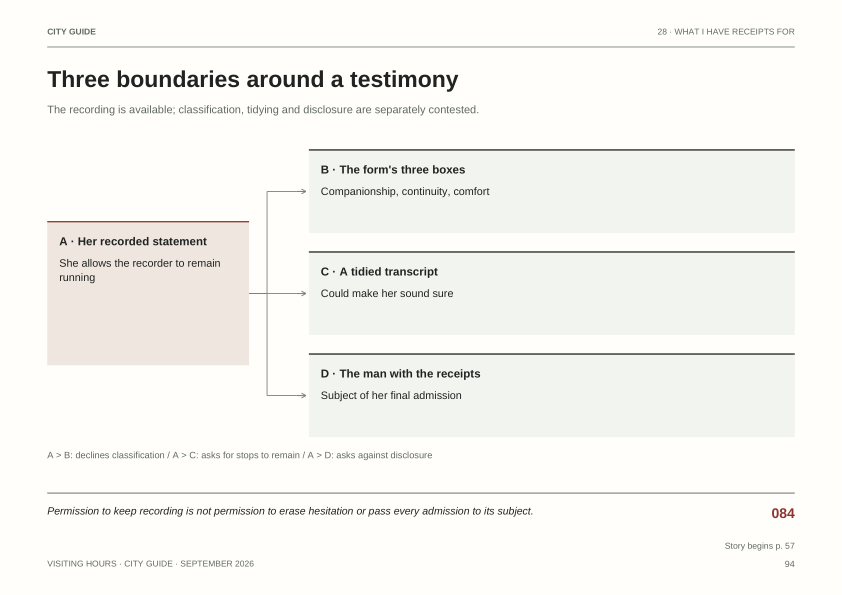
The recording is available; classification, tidying and disclosure are separately contested.
- Her recorded statement
- She allows the recorder to remain running
- The form's three boxes
- Companionship, continuity, comfort
- A tidied transcript
- Could make her sound sure
- The man with the receipts
- Subject of her final admission
Relationships
- Her recorded statement → The form's three boxes: declines classification
- Her recorded statement → A tidied transcript: asks for stops to remain
- Her recorded statement → The man with the receipts: asks against disclosure
Permission to keep recording is not permission to erase hesitation or pass every admission to its subject.