Read the story · Download the guide
5. Cheap Words
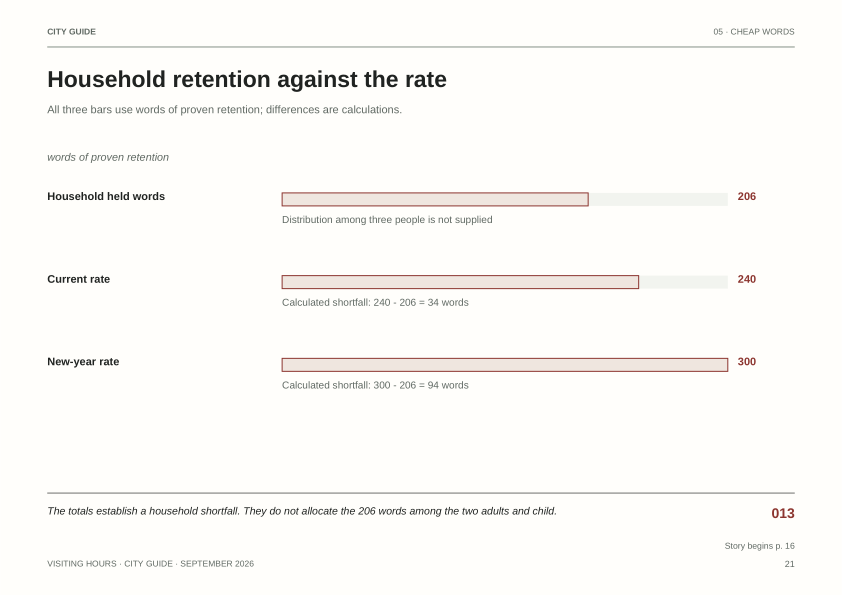
All three bars use words of proven retention; differences are calculations.
words of proven retention
| Item | Value | Detail |
|---|---|---|
| Household held words | 206 | Distribution among three people is not supplied |
| Current rate | 240 | Calculated shortfall: 240 - 206 = 34 words |
| New-year rate | 300 | Calculated shortfall: 300 - 206 = 94 words |
The totals establish a household shortfall. They do not allocate the 206 words among the two adults and child.
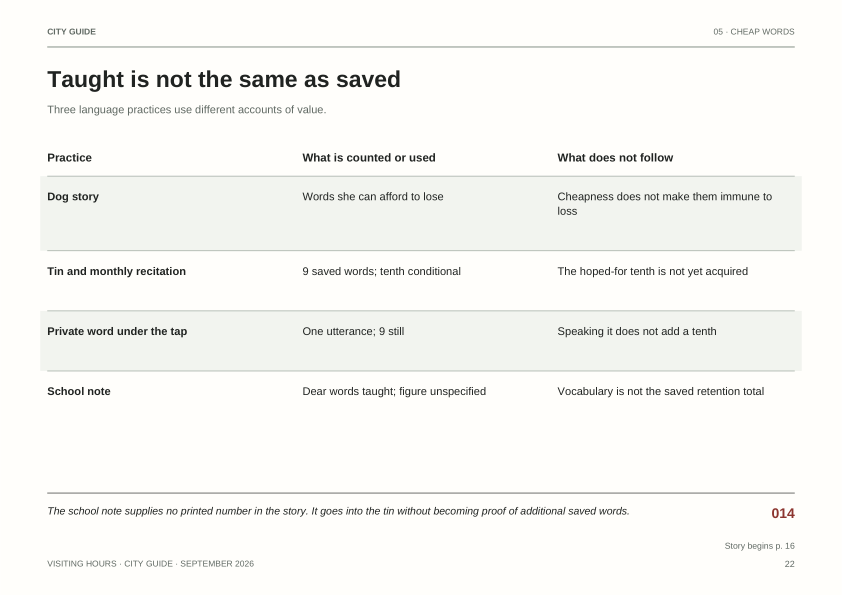
Three language practices use different accounts of value.
| Practice | What is counted or used | What does not follow |
|---|---|---|
| Dog story | Words she can afford to lose | Cheapness does not make them immune to loss |
| Tin and monthly recitation | 9 saved words; tenth conditional | The hoped-for tenth is not yet acquired |
| Private word under the tap | One utterance; 9 still | Speaking it does not add a tenth |
| School note | Dear words taught; figure unspecified | Vocabulary is not the saved retention total |
The school note supplies no printed number in the story. It goes into the tin without becoming proof of additional saved words.
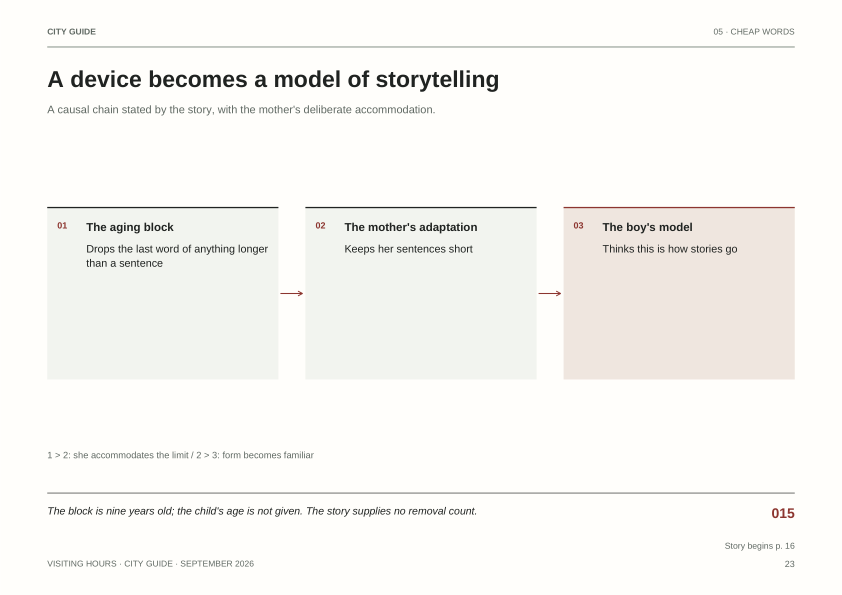
A causal chain stated by the story, with the mother's deliberate accommodation.
- The aging block
- Drops the last word of anything longer than a sentence
- The mother's adaptation
- Keeps her sentences short
- The boy's model
- Thinks this is how stories go
Relationships
- The aging block → The mother's adaptation: she accommodates the limit
- The mother's adaptation → The boy's model: form becomes familiar
The block is nine years old; the child's age is not given. The story supplies no removal count.