Read the story · Download the guide
59. The Liminal
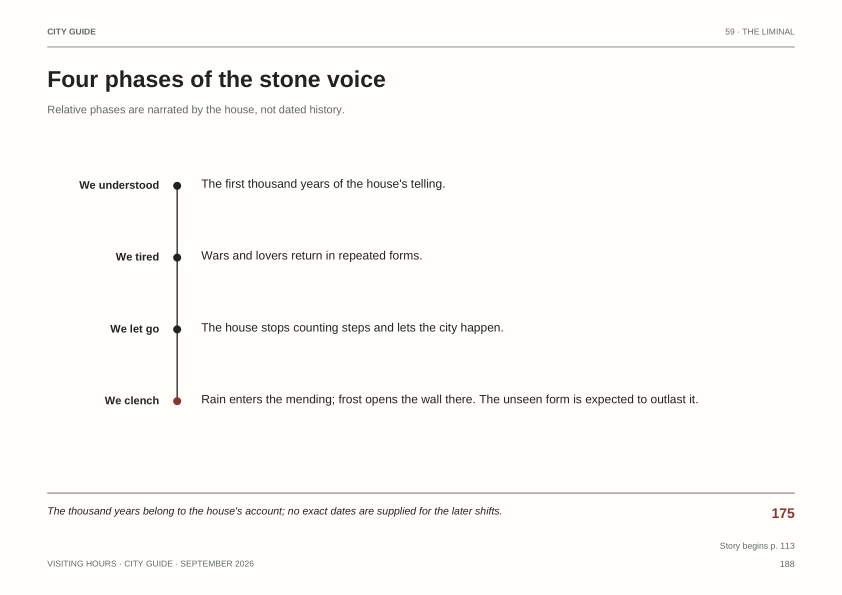
Relative phases are narrated by the house, not dated history.
- We understood
- The first thousand years of the house's telling.
- We tired
- Wars and lovers return in repeated forms.
- We let go
- The house stops counting steps and lets the city happen.
- We clench
- Rain enters the mending; frost opens the wall there. The unseen form is expected to outlast it.
The thousand years belong to the house's account; no exact dates are supplied for the later shifts.
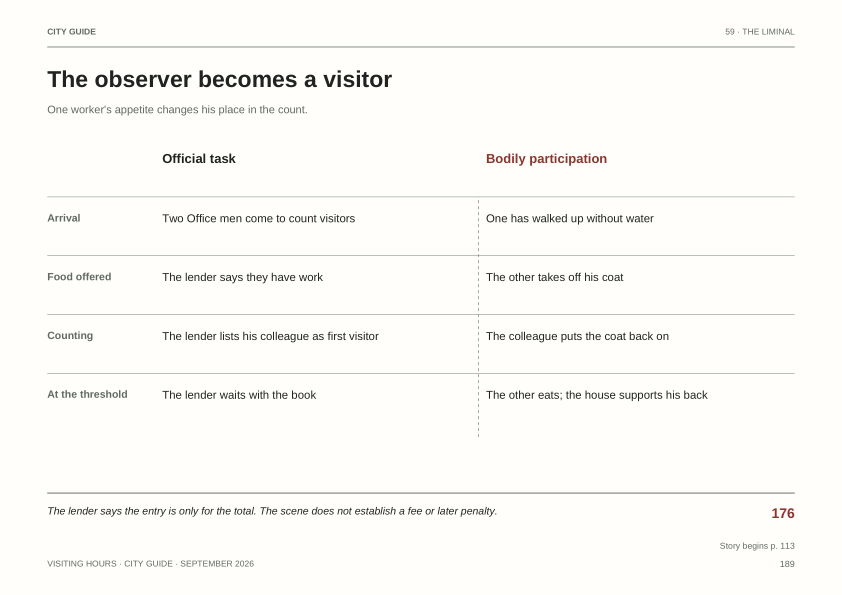
One worker's appetite changes his place in the count.
| Official task | Bodily participation | |
|---|---|---|
| Arrival | Two Office men come to count visitors | One has walked up without water |
| Food offered | The lender says they have work | The other takes off his coat |
| Counting | The lender lists his colleague as first visitor | The colleague puts the coat back on |
| At the threshold | The lender waits with the book | The other eats; the house supports his back |
The lender says the entry is only for the total. The scene does not establish a fee or later penalty.
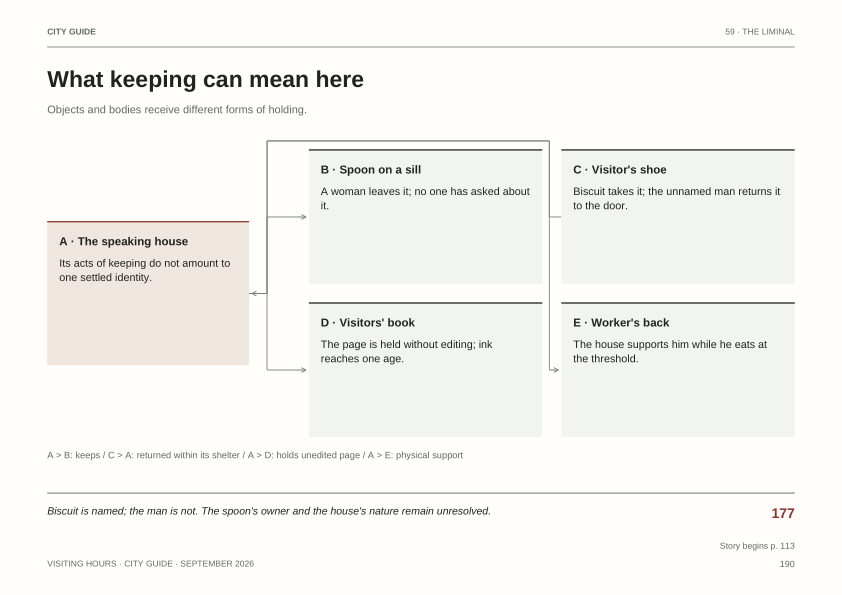
Objects and bodies receive different forms of holding.
- The speaking house
- Its acts of keeping do not amount to one settled identity.
- Spoon on a sill
- A woman leaves it; no one has asked about it.
- Visitor's shoe
- Biscuit takes it; the unnamed man returns it to the door.
- Visitors' book
- The page is held without editing; ink reaches one age.
- Worker's back
- The house supports him while he eats at the threshold.
Relationships
- The speaking house → Spoon on a sill: keeps
- Visitor's shoe → The speaking house: returned within its shelter
- The speaking house → Visitors' book: holds unedited page
- The speaking house → Worker's back: physical support
Biscuit is named; the man is not. The spoon's owner and the house's nature remain unresolved.