Read the story · Download the guide
6. Kept
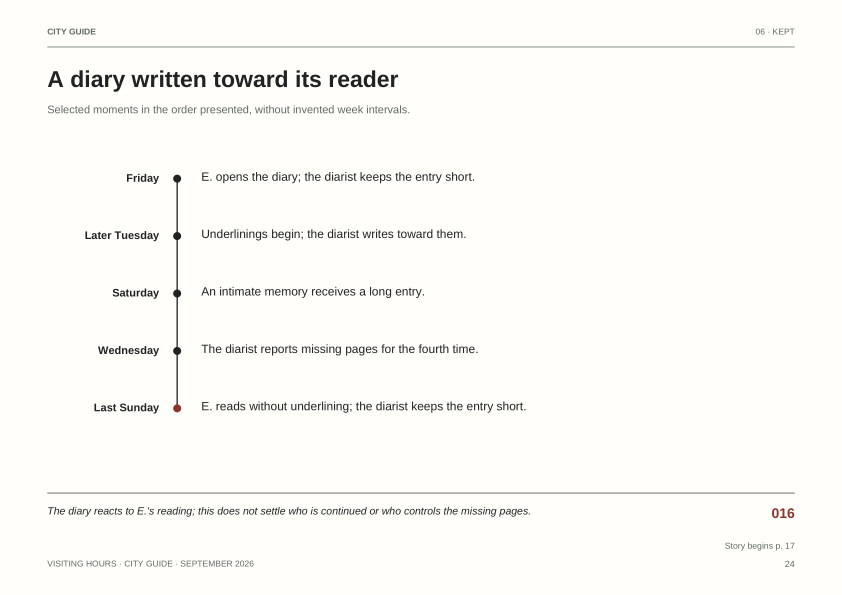
Selected moments in the order presented, without invented week intervals.
- Friday
- E. opens the diary; the diarist keeps the entry short.
- Later Tuesday
- Underlinings begin; the diarist writes toward them.
- Saturday
- An intimate memory receives a long entry.
- Wednesday
- The diarist reports missing pages for the fourth time.
- Last Sunday
- E. reads without underlining; the diarist keeps the entry short.
The diary reacts to E.'s reading; this does not settle who is continued or who controls the missing pages.
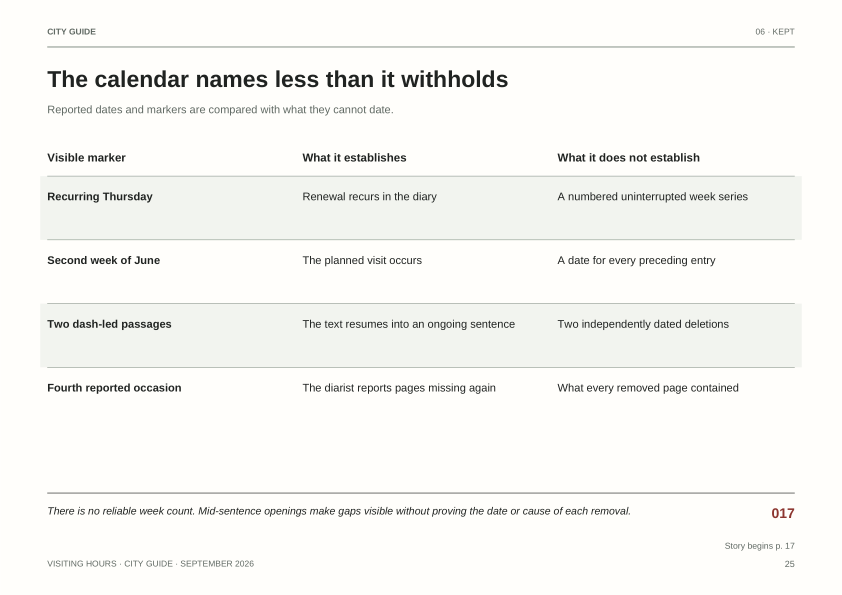
Reported dates and markers are compared with what they cannot date.
| Visible marker | What it establishes | What it does not establish |
|---|---|---|
| Recurring Thursday | Renewal recurs in the diary | A numbered uninterrupted week series |
| Second week of June | The planned visit occurs | A date for every preceding entry |
| Two dash-led passages | The text resumes into an ongoing sentence | Two independently dated deletions |
| Fourth reported occasion | The diarist reports pages missing again | What every removed page contained |
There is no reliable week count. Mid-sentence openings make gaps visible without proving the date or cause of each removal.
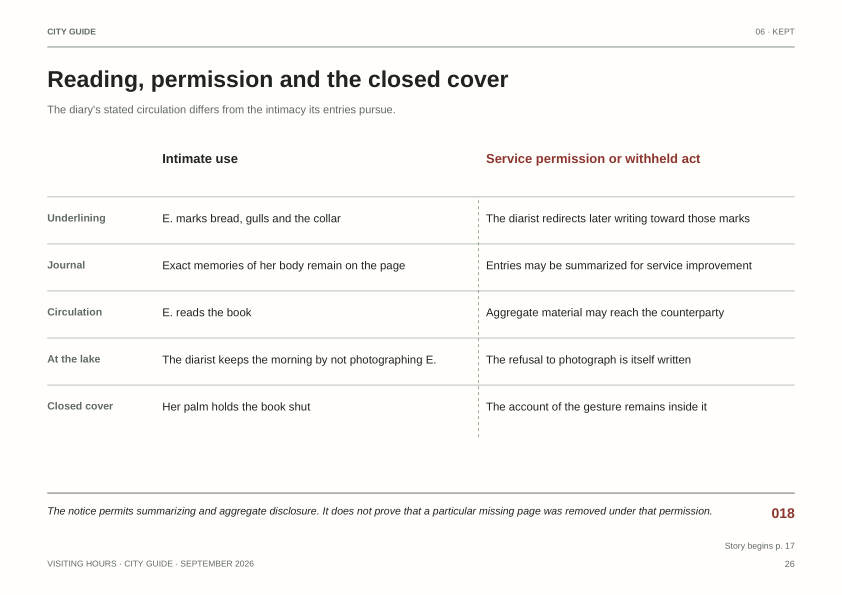
The diary's stated circulation differs from the intimacy its entries pursue.
| Intimate use | Service permission or withheld act | |
|---|---|---|
| Underlining | E. marks bread, gulls and the collar | The diarist redirects later writing toward those marks |
| Journal | Exact memories of her body remain on the page | Entries may be summarized for service improvement |
| Circulation | E. reads the book | Aggregate material may reach the counterparty |
| At the lake | The diarist keeps the morning by not photographing E. | The refusal to photograph is itself written |
| Closed cover | Her palm holds the book shut | The account of the gesture remains inside it |
The notice permits summarizing and aggregate disclosure. It does not prove that a particular missing page was removed under that permission.