Read the story · Download the guide
16. Therefore
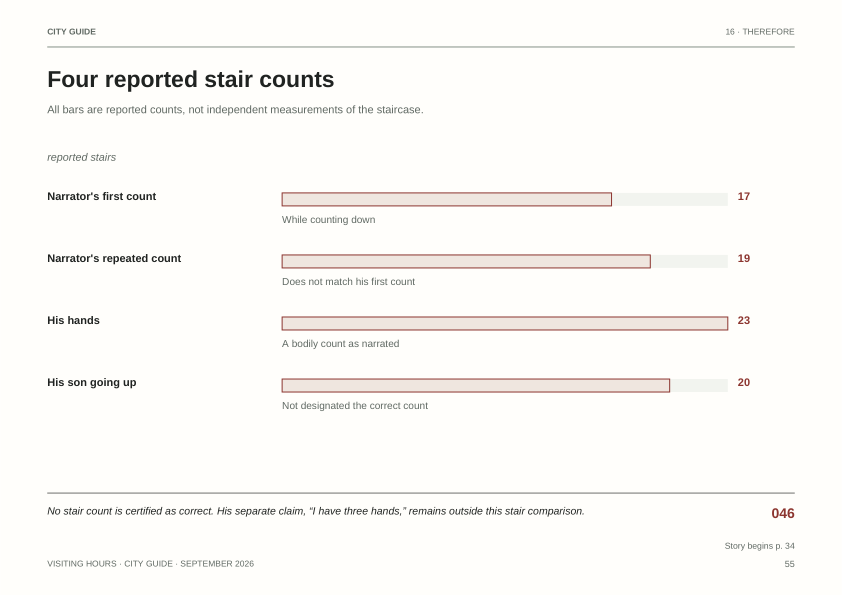
All bars are reported counts, not independent measurements of the staircase.
reported stairs
| Item | Value | Detail |
|---|---|---|
| Narrator's first count | 17 | While counting down |
| Narrator's repeated count | 19 | Does not match his first count |
| His hands | 23 | A bodily count as narrated |
| His son going up | 20 | Not designated the correct count |
No stair count is certified as correct. His separate claim, “I have three hands,” remains outside this stair comparison.
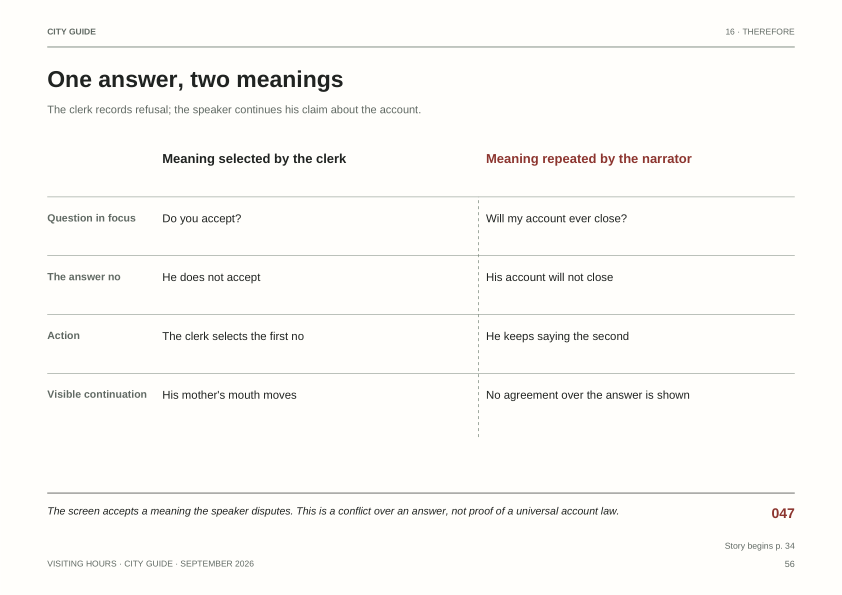
The clerk records refusal; the speaker continues his claim about the account.
| Meaning selected by the clerk | Meaning repeated by the narrator | |
|---|---|---|
| Question in focus | Do you accept? | Will my account ever close? |
| The answer no | He does not accept | His account will not close |
| Action | The clerk selects the first no | He keeps saying the second |
| Visible continuation | His mother's mouth moves | No agreement over the answer is shown |
The screen accepts a meaning the speaker disputes. This is a conflict over an answer, not proof of a universal account law.
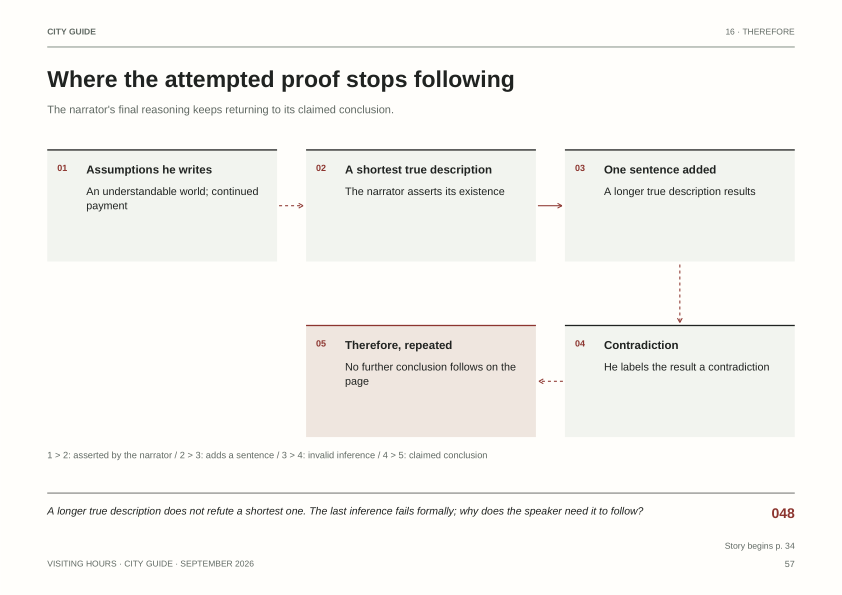
The narrator's final reasoning keeps returning to its claimed conclusion.
- Assumptions he writes
- An understandable world; continued payment
- A shortest true description
- The narrator asserts its existence
- One sentence added
- A longer true description results
- Contradiction
- He labels the result a contradiction
- Therefore, repeated
- No further conclusion follows on the page
Relationships
- Assumptions he writes → A shortest true description: asserted by the narrator (reported, incomplete, disputed or interpretive connection)
- A shortest true description → One sentence added: adds a sentence
- One sentence added → Contradiction: invalid inference (reported, incomplete, disputed or interpretive connection)
- Contradiction → Therefore, repeated: claimed conclusion (reported, incomplete, disputed or interpretive connection)
A longer true description does not refute a shortest one. The last inference fails formally; why does the speaker need it to follow?