Current Forum and Next Work
v2.0.0 release — 17 July 2026. The author-led phase has reached its responsible stopping point with the status author-completed / research-open / independently continuable / not validated. Read Where We Stopped or see how continuation may proceed. The v1.9 Forum below remains an immutable part of the released project record.
Uncommon Reality has completed a long-form internal criticism forum on the project’s intellectual history, failures, presentation, and delivery. The forum used the project’s named experts and advisors only as simulated intellectual standpoints. They did not participate, endorse the project, or speak these words. This work is structured self-criticism, not independent expert review, affected-party participation, or empirical evidence.
The conclusion in one paragraph
The project is currently strongest as a governed research programme and interpretive synthesis, not as a validated cross-domain causal theory. Its public claim, evidence, revision, edition, and release machinery has become more mature than its prospective empirical work. The next phase therefore combines clearer public delivery with the infrastructure for one future discriminating comparison. No claim has been promoted. No prospective test has begun. Real domain, affected-party, real-reader, assistive-technology, and broader rendered live-site review remain open.
Read, listen, save, or share
Every public page now carries a Print / Save PDF control and a canonical Share action. A browser-saved PDF is a convenience copy of the current live page, not a checksum-registered project edition. The links below also open the three separately edited narration views and their immutable narration PDFs.
Systems theories and the project approach
This report traces systems traditions without treating them as a straight line culminating in Uncommon Reality. It then locates the project’s theory spine, lens, modules, mechanisms, evidence maturity, contribution, and limits.
- Read the structured web report
- Read the continuous-listening narration view
- Download the report PDF
- Download the narration PDF
What we did wrong
This is the project’s unprotected self-audit: 38 specific failure autopsies, their consequences, repairs already made, remaining exposure, and a preserved minority case for more radical restraint.
- Read the structured web report
- Read the continuous-listening narration view
- Download the report PDF
- Download the narration PDF
Improvement and final delivery programme
This programme specifies what can be improved now, what is only research infrastructure, what requires real review, what must wait, and how implementation should be checked.
- Read the structured web report
- Read the continuous-listening narration view
- Download the report PDF
- Download the narration PDF
The report PDFs are selectable-text, designed publications. The narration PDFs are separately adapted for continuous listening rather than duplicate layouts. Neither form is claimed to be accessibility-certified; the structured web reports remain the text-first alternatives pending real assistive-technology review.
What changed now
- the forum’s mechanics, disagreements, co-chair comments, and implementation decisions have a canonical internal record;
- three report families and three listening companions have immutable dated editions and checksums;
- this hub makes the work findable without requiring internal report IDs;
- two canonical diagrams now explain the bounded repair episode and the theory architecture with text alternatives;
- a prospective-test schema now exists, with one infrastructure-only C3 design stub;
- document lifecycle status is explicit so a historical plan cannot silently pose as the current plan;
- the Plan, Method, project state, decisions, skills, metrics, source index, report series, and edition history are reconciled.
What did not change
- Repair-Lag Systems Theory remains developing and provisional.
- The evidence map still contains no completed prospective discriminating test.
- The new T001 record is not a preregistration, running test, result, or evidence.
- C1–C8 retain their current research states; RQ1 remains a research question and M1 a method commitment.
- CS001–CS003 remain bounded illustration stubs. The co-chairs deferred deepening one until its source, pinpoint, real-review, and non-promotion gates are ready.
- No simulated standpoint supplies independent review, legitimacy, consent, or lived experience.
- Partial rendered verification completed on 14 July 2026: desktop Chrome structure, keyboard focus, and horizontal-overflow checks passed. Narrow-mobile, 200% and 400% zoom, screen-reader, forced-colors, no-JavaScript, and real-human testing remain open. Tested private and internal routes separately returned HTTP 404 during the v1.9 release; that bounded route check is not a general security audit.
Diagram 1 — Where can repair fail in a bounded episode?
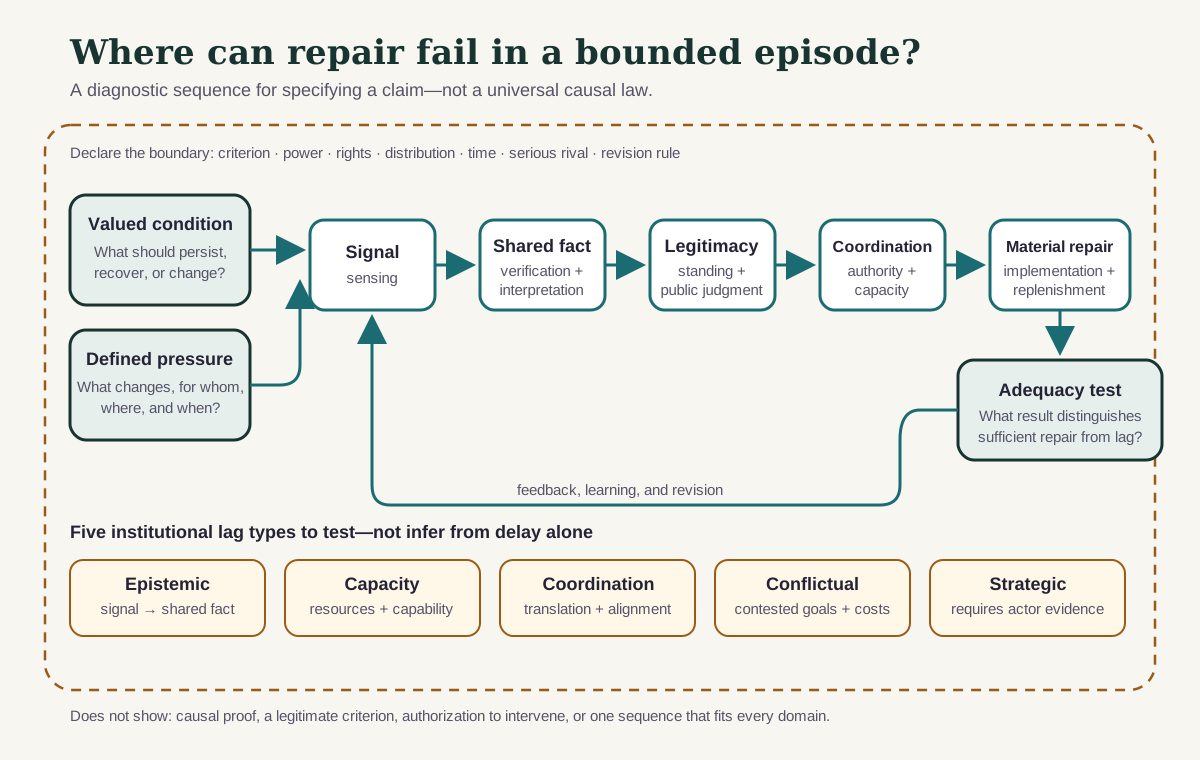
Long description. The figure begins with two required declarations: a valued condition and a defined pressure. They feed a sequence of signal, shared fact, legitimacy, coordination, and material repair. An adequacy test asks what observable result separates sufficient repair from lag; feedback returns to sensing and learning. Five institutional lag types sit below the sequence. Epistemic lag concerns signal becoming shared fact. Capacity lag concerns resources and capability. Coordination lag concerns translation and alignment. Conflictual lag concerns contested goals and costs. Strategic lag may be named only with actor-level evidence. A surrounding boundary requires the criterion, power, rights, distribution, time period, serious rival, and revision rule to be declared.
The figure does not show causal proof, a legitimate criterion, authorization to intervene, or a universal sequence that fits every domain.
Diagram 2 — How is the current theory architecture organized?
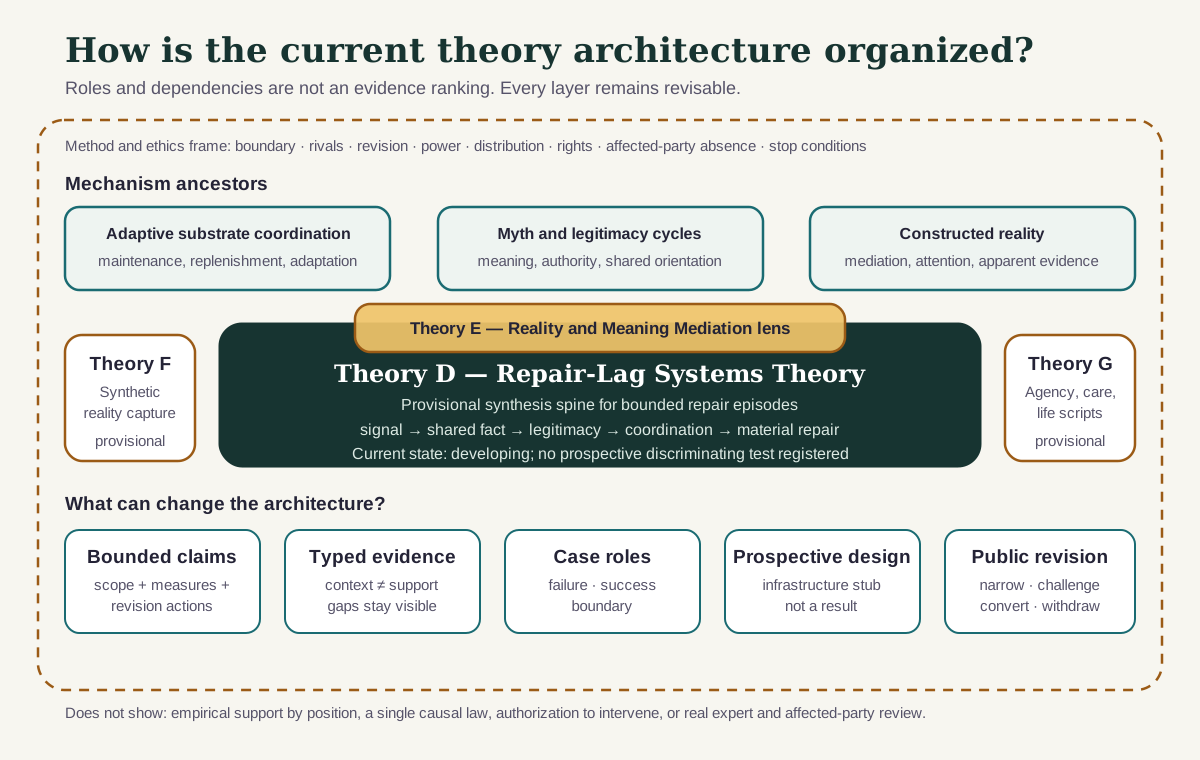
Long description. Three mechanism ancestors—adaptive substrate coordination, myth and legitimacy cycles, and constructed reality—sit above the provisional Repair-Lag Systems Theory spine. The Reality and Meaning Mediation lens crosses that spine. The Synthetic Reality Capture module and the Reproductive Agency, Care, and Life Scripts module sit beside it. Below are the records that can change the architecture: bounded claims, typed evidence, distinct case roles, prospective design, and public revision. A surrounding method and ethics frame requires boundaries, rivals, revision rules, power and distribution analysis, rights, affected-party absence, and stop conditions.
The figure does not show empirical support by vertical position, a single causal law, authorization to intervene, or real expert and affected-party review.
Prospective-design infrastructure: T001
T001 is an infrastructure-only design stub linked to C3. It asks how a future matched comparison might distinguish an incremental synthetic-voice verification burden from the rival explanation that conventional deception, distribution, urgency, partisan priors, and baseline distrust account for the observed burden. Case selection, dates, operational measures, data, adequacy criterion, analysis plan, decision rule, missing-data rule, and real review remain undefined. Outcomes have not been inspected.
Inspect the public Method and its stop conditions
Next public actions
- compare candidate prospective designs before selecting incidents or inspecting outcomes;
- obtain bounded real domain and affected-party review for the selected design and its criterion;
- complete real reader and assistive-technology testing of the live site and the paired publications;
- build a case-readiness comparison before choosing which legacy illustration to deepen;
- add source pinpoints and freshness coverage for the selected research path;
- preserve dissent and publish revisions when new evidence or external criticism changes the project.
Browse all editions and previous versions · Open the Download Center · Return to Start