Production Statistics
Vera / Віра — a quantitative companion
Compiled from Vera-METHODOLOGY.pdf v0.6, Vera-production-stream-metrics.pdf v0.4 (with Chat 48 absolute close increment), and Vera-project-metrics.pdf (Chat 48 absolute close).
May 4, 2026
Headline findings
| Metric | Value |
|---|---|
| Surviving manuscript | 75,943 words |
| Total machine output | ~30.28 million words |
| Process artifacts (durable record) | 1,201,778 words |
| Survival ratio | 0.25% |
| Generated-to-final ratio | ~399× |
| Confirmations-to-implementations (Chat 48 fifth-cycle Phase 2B) | saturation: 0 implementations |
| Process-residue per word of change (Chats 46–48) | ~876× |
| Catches logged and resolved | 87 |
| Code sessions across two machines | 28 (carry-forward from Chat 43 measurement) |
| external-input-fix-protocol cumulative uses | 26 |
| extended-masters-session cumulative uses | 7 |
| surgical-style-pass cumulative uses | 9 |
| solo-master-led extended-editorial-pass cumulative uses | 1 (Chat 48 final close) |
Executive summary
This is a quantitative report on the production of Vera / Віра — a 75,943-word literary novel co-written by Hulki Okan Tabak with the Anthropic Claude language model across forty-eight chat sessions, twenty-eight Code sessions on two machines, and approximately fifteen months of work. It supplements the methodology document (which records how the work was done) and the production-stream-metrics document (which records the four streams of words that flowed through the process). What this report adds is the visualization — eight charts that make the project's shape visible at a glance.
The dominant finding is convergence, confirmed across six independent measurement passes. The survival ratio — surviving manuscript words divided by total machine output — has held at approximately one-quarter of one percent. The book has reached architectural saturation: Chats 46–48 produced a process-residue-to-manuscript-change ratio of approximately 876×, an order of magnitude above the Chats 44–45 ratio of 468× and two orders above the Chats 38–43 ratio of 5×. The Chat 47 fourth-cycle two-stage whole-book editorial pass returned zero surgical implementations; the Chat 48 fifth-cycle Phase 2B typographic-register extraordinary-session returned zero manuscript changes (5 ratifications + 1 consistency-check pass); the Chat 48 final close solo-Master 3 S-led extended editorial pass returned zero further changes. Saturation has been confirmed three times now.
The eight charts that follow document this convergence at unit-level granularity. They are presented in the order the methodology produces them: from the structural frame (the four streams) through the convergence finding (the survival asymptote), through the durable record (Stream 4 composition), through the saturation phase change (process-residue ratio jump and confirmations:implementations), through the production infrastructure (per-machine, token economy), to the manuscript's own trajectory (drafting peak to saturation floor).
The metric that matters is in the last sentence of the book, and in the silence after. The metrics in this report describe the work that produced both.
1. The four streams
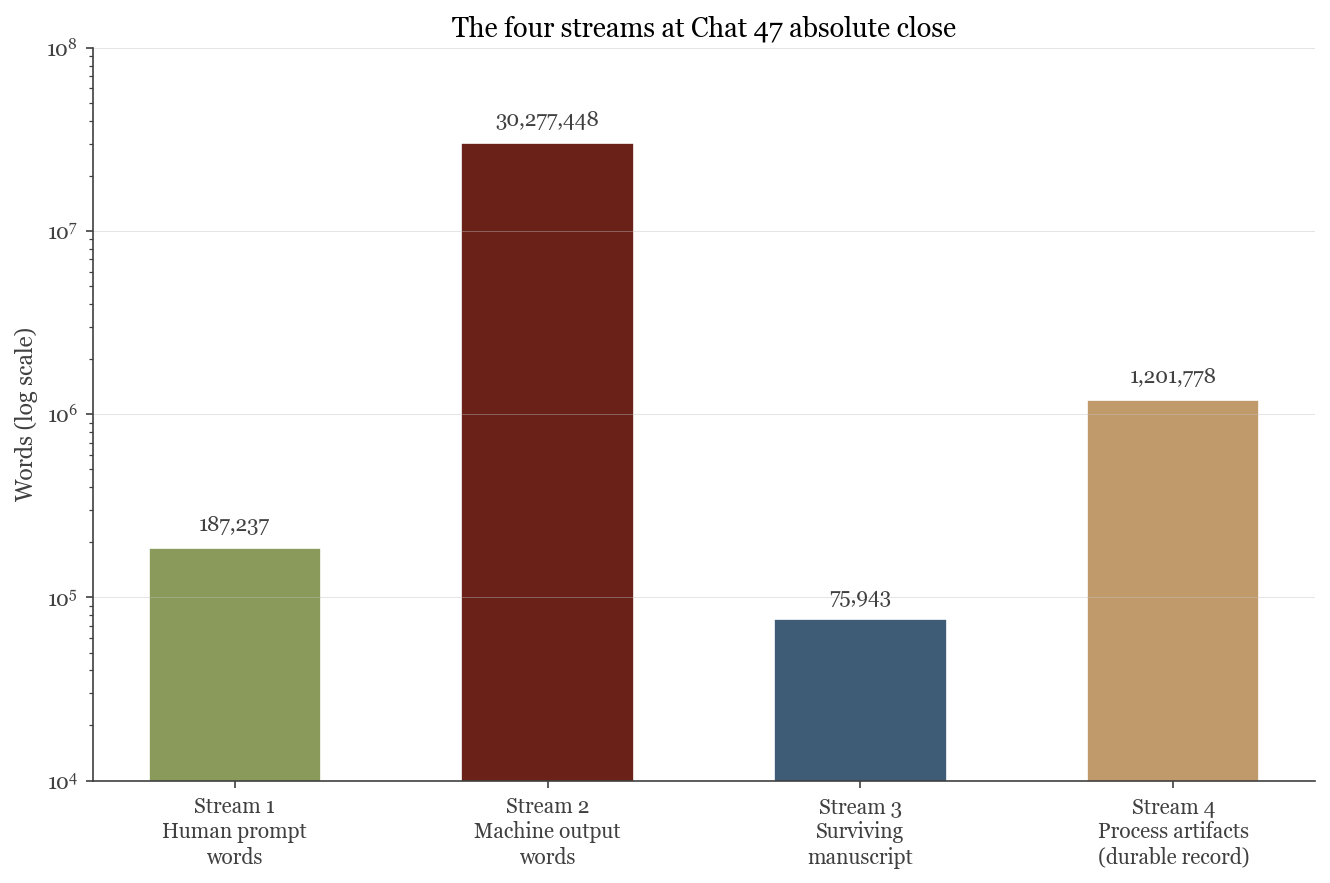
The project tracks four word-streams: human prompt input, machine generation output, surviving manuscript, and the durable process residue (reviews, skill files, methodology documents). The streams span five orders of magnitude. Stream 2 (machine output) is roughly 162× larger than Stream 1 (human prompts), 399× larger than Stream 3 (the manuscript), and 25× larger than Stream 4 (durable process record). Stream 4 is itself 15.8× larger than the manuscript it documents — up from 15.6× at the Chat 47 measurement, reflecting the Chat 48 reviews-artifact + canon-cascade growth.
The chart's shape encodes the method. The book is the smallest stream. The book's methodology — the audits, the panel transcripts, the canon files, the reviews artifacts — is now nearly sixteen times larger than the book itself. The machine output is four hundred times larger than the book. And the human prompting that directed the machine output is roughly two-and-a-half times the book's own size.
The 2.47× human-prompt-to-final ratio is worth noting. Across forty-eight chat sessions and twenty-eight Code sessions, Hulki Okan Tabak typed approximately 187,237 words of direction to produce a 75,943-word novel. That ratio is the human-direction density of the method: roughly one prompt-word per third of a manuscript-word. Most of those prompt-words are not "write the next sentence" — most are architectural direction, audit specification, and protocol routing. The writer is not dictating the prose; the writer is directing the work that curates the prose into being.
2. The survival ratio asymptote
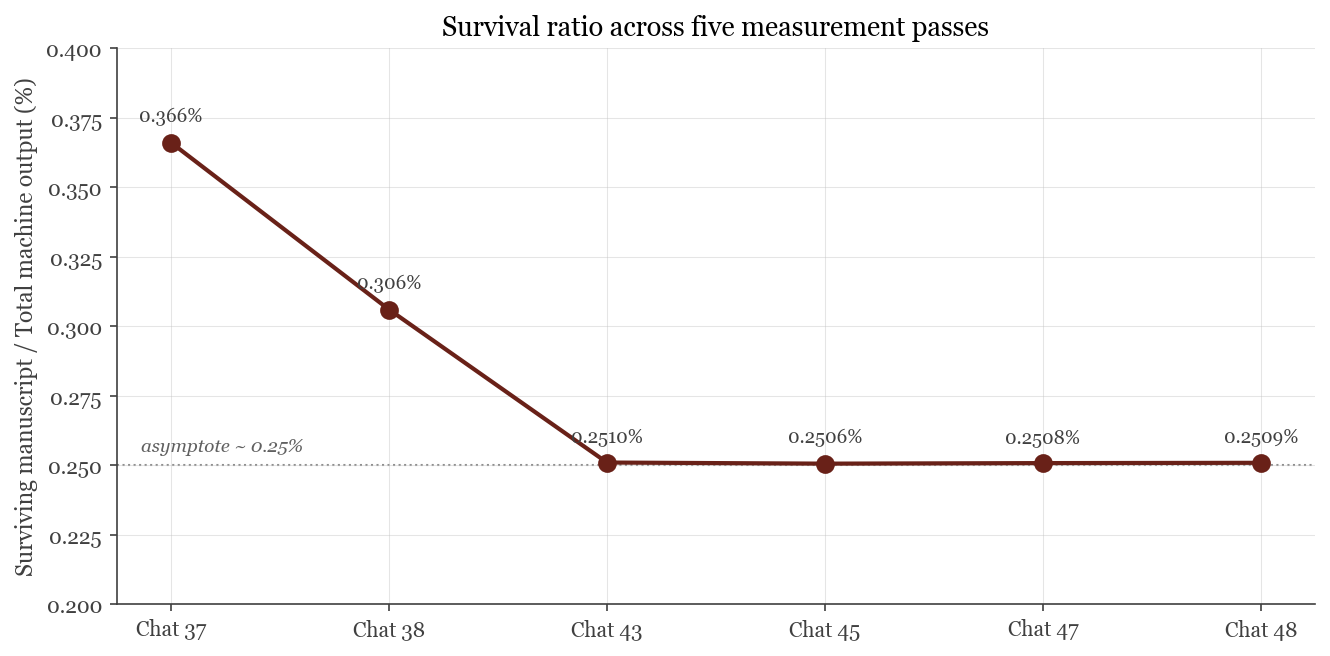
The most diagnostic single metric in the project is the survival ratio: the fraction of total machine output that becomes surviving manuscript. The ratio has now been measured six times across the project's life. It has converged.
The ratio declined from 0.366% at Chat 37 to 0.306% at Chat 38 to 0.251% at Chat 43 to 0.2506% at Chat 45 fifth-cycle to 0.2508% at Chat 47 absolute close to 0.2509% at Chat 48 absolute close. The Chat 48 number is essentially identical to Chat 47 (one part in ten thousand) because the manuscript moved -2 words while machine output continued to accumulate. The asymptote has crystallized at approximately 0.25%; this is the project's stable floor.
The shape of the curve is the project's honest accounting. Approximately one manuscript-word survives for every four-hundred machine-words generated. The inverse — that 99.75% of what the machine wrote did not become the book — is where the writer's discipline lives. The work is not in the generation. The work is in the selection, the cutting, the refusal. The ratio measures the cost of the discipline: every published sentence sits on top of approximately four hundred unpublished ones, most of which were never seen by anyone except the writer who chose against them.
The asymptote's convergence to a stable floor is the saturation signature. When a manuscript has reached architectural saturation, additional work produces process residue without producing manuscript change. The ratio cannot fall below the floor without manuscript loss; the manuscript stops losing words; the ratio stops moving. Vera has now held this state across five chats — 44, 45, 46, 47, and 48 — with the floor confirmed by three saturation-class operations: the Chat 47 fourth-cycle two-stage whole-book editorial pass (zero implementations), the Chat 48 fifth-cycle Phase 2B typographic-register extraordinary-session (zero manuscript changes; 5 ratifications + 1 consistency-check pass from 6 candidates), and the Chat 48 final close solo-Master 3 S-led extended editorial pass (LEAVE all 8 changed-areas).
3. What the durable record looks like
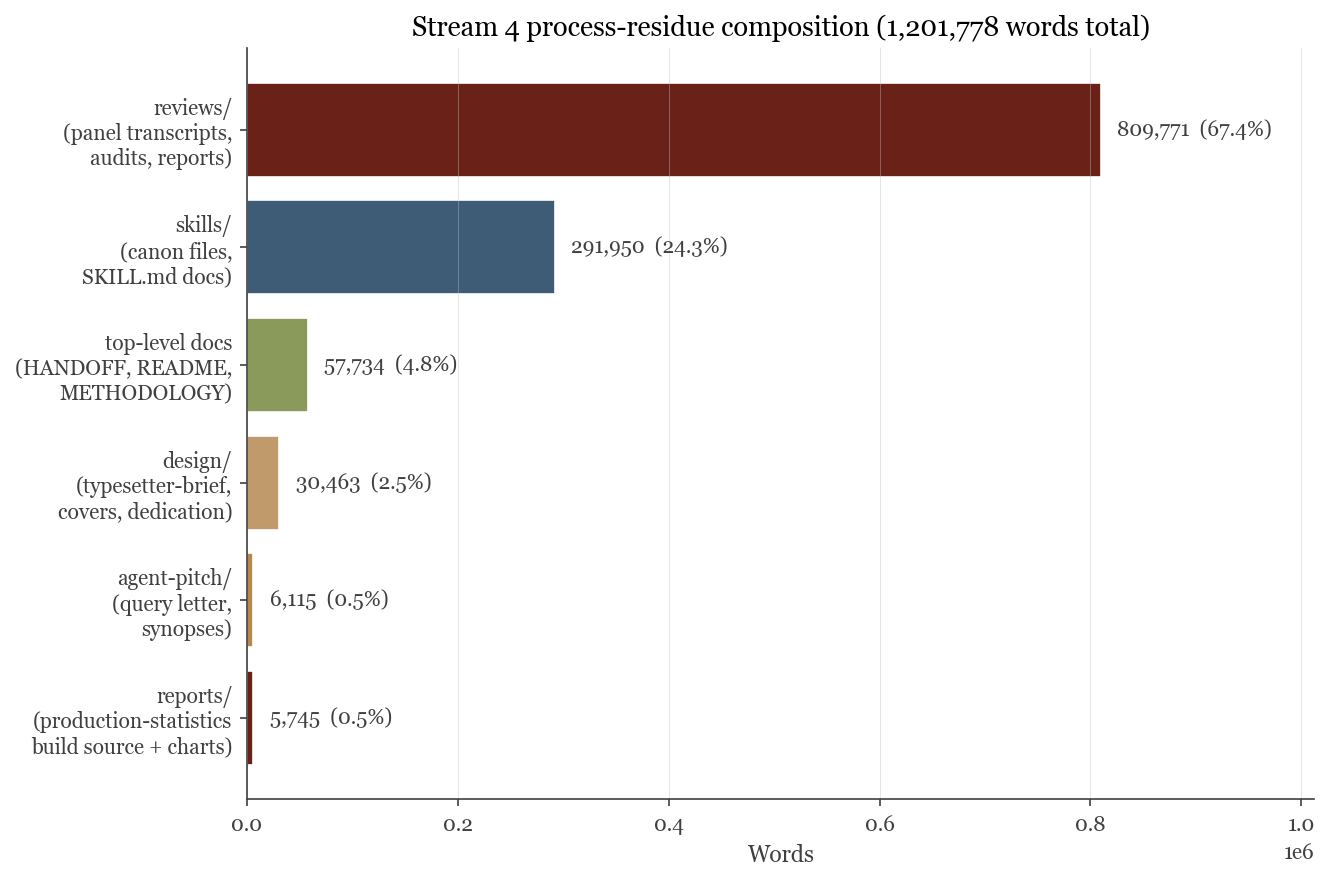
Stream 4 — the process residue — is the durable record of how the book was made. At 1,201,778 words it is nearly sixteen times the manuscript. Its composition tells a specific story about the method.
Reviews — panel transcripts, audit reports, protocol synthesis documents — account for 67.4% of the durable record at 809,771 words. The reviews directory is the project's longest-running written artifact, accumulating one document per masters-round, one per editorial-pass cycle, one per architectural-rupture session, one per external-critic adjudication, one per audiobook-cold-read fix-pass. Each reviews artifact preserves the full panel transcript with master voicings, per-round verdicts, the author's green-light decisions, and Master 3 S's closing question. The Chat 46–47 cycles alone added several new reviews artifacts including the whole-book multi-agent editorial pass synthesis, the audiobook-cold-read fix-passes, the W2 final halo Ch XI implementation record, the 5-item external-review panel record, the triplet-meter-pass implementation record, and the two-stage editorial-pass saturation-confirmation record.
Skills (24.3%) is the second-largest component: the SKILL.md files for chat-advisor, chat-advisor-vera, book-editorial, six-literary-masters, extended-masters-session, external-input-fix-protocol, surgical-style-pass, and triplet-meter-pass — plus the twelve reference files under book-writing/references/ that constitute the Vera architectural canon. Skills grew from 290,059 to 291,950 words across Chat 48 — driven by the chat-advisor-vera SKILL's expansion through v7 → v8, the auden-and-the-decade bump to v0.8, and the architecture-seven-books bump to v0.54 → v0.55 canonizing the Phase 2B typographic-register architectures.
Top-level documents (4.8%) are the always-loaded operational layer: HANDOFF, CLAUDE.md, README.md, METHODOLOGY.md, BOOK-WORKFLOW.md, and the per-chat opening prompts. METHODOLOGY grew from ~1010 to ~1180 lines across Chat 48 (v0.5 → v0.6 with 6 new precedents §9.45-§9.50). Design (2.5%) is the typesetter-brief and cover specs. Agent-pitch (0.5%) is the publication-package material — query letter, synopses, comparative titles, author bio. Reports/ (0.5%) is the new directory at Chat 48 first-cycle: the production-statistics.md prose source + matplotlib build script + 8 chart PNGs that produce this very report.
The composition's shape — reviews dominating at 67.4% — is the method's admission that what produces the book is not a fixed canon but an ongoing record of deliberation. The canon files are 24.3% of the durable record; the transcripts of how decisions were reached are 67.4%. The book is in some real sense the residue of having argued about it for forty-eight chats.
4. The saturation phase change
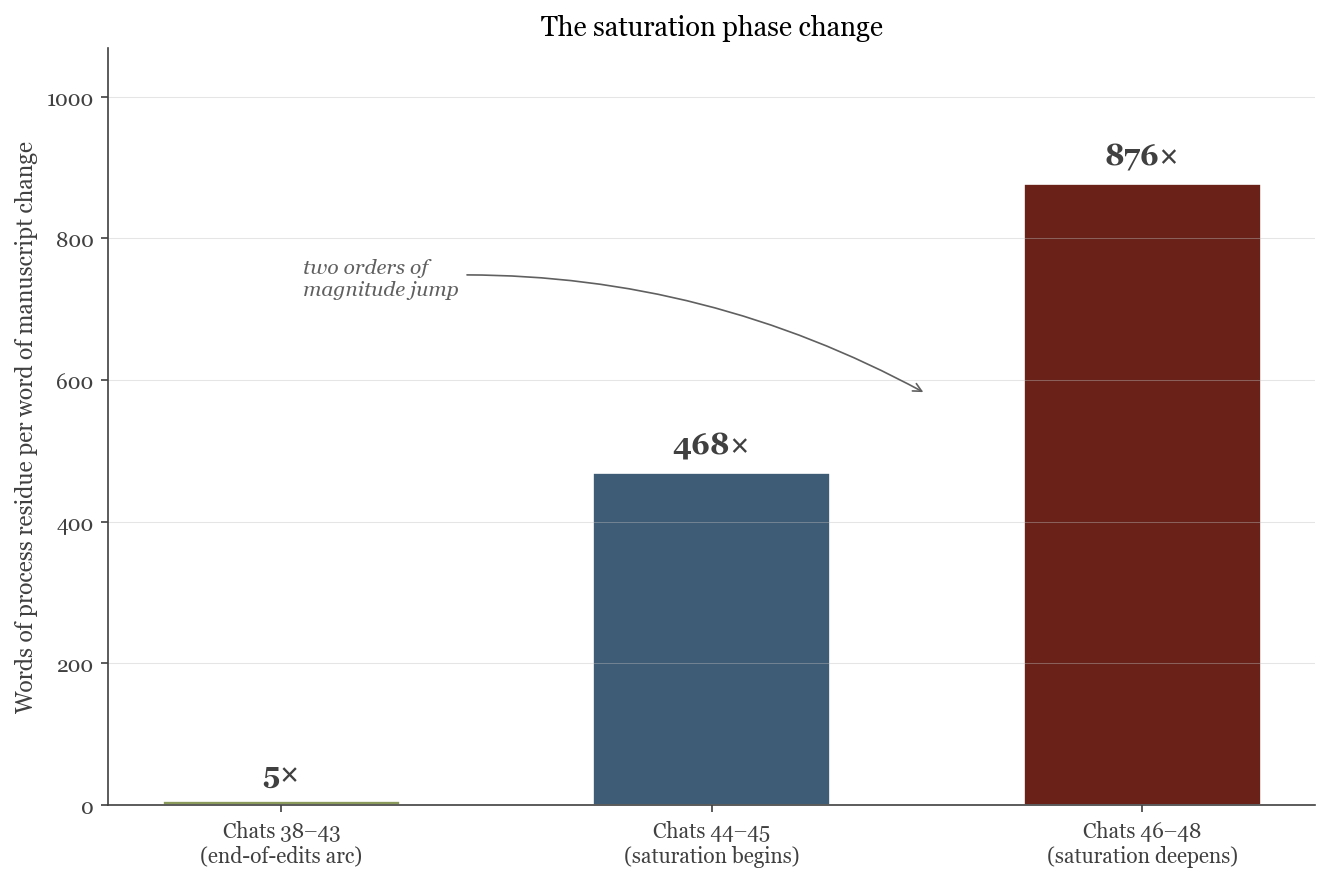
Across Chats 38–43 (the active publication-prep arc) the process-residue growth rate ran at approximately five times the rate of manuscript change. Across Chats 44–45 — after the first end-of-edits declaration — that ratio jumped to approximately 468×. Across Chats 46–48, with the systematic-edit phase formally closed at Chat 46 fourth-cycle and Chat 48 producing six sub-cycles of canon-cascade and methodological-housekeeping work, it has jumped again to approximately 876×. Each window represents a deeper saturation: the protocol still runs, the reviews still get written, but the manuscript stays where it is.
The interpretation: when a manuscript is still being shaped, process residue and manuscript change grow at comparable rates because each cycle of work both documents the deliberation and lands edits. When the manuscript has reached architectural saturation, additional work continues to document deliberation but stops landing edits. The Chat 46–48 increment of +94,608 process-residue words against a +108-word net manuscript change (the manuscript moved from 75,835 to 75,943) produced the highest saturation ratio yet seen on the project.
The companion metric is the implementations-to-LEAVE-confirmations ratio across recent cycles, which makes the saturation visible at unit-level granularity:
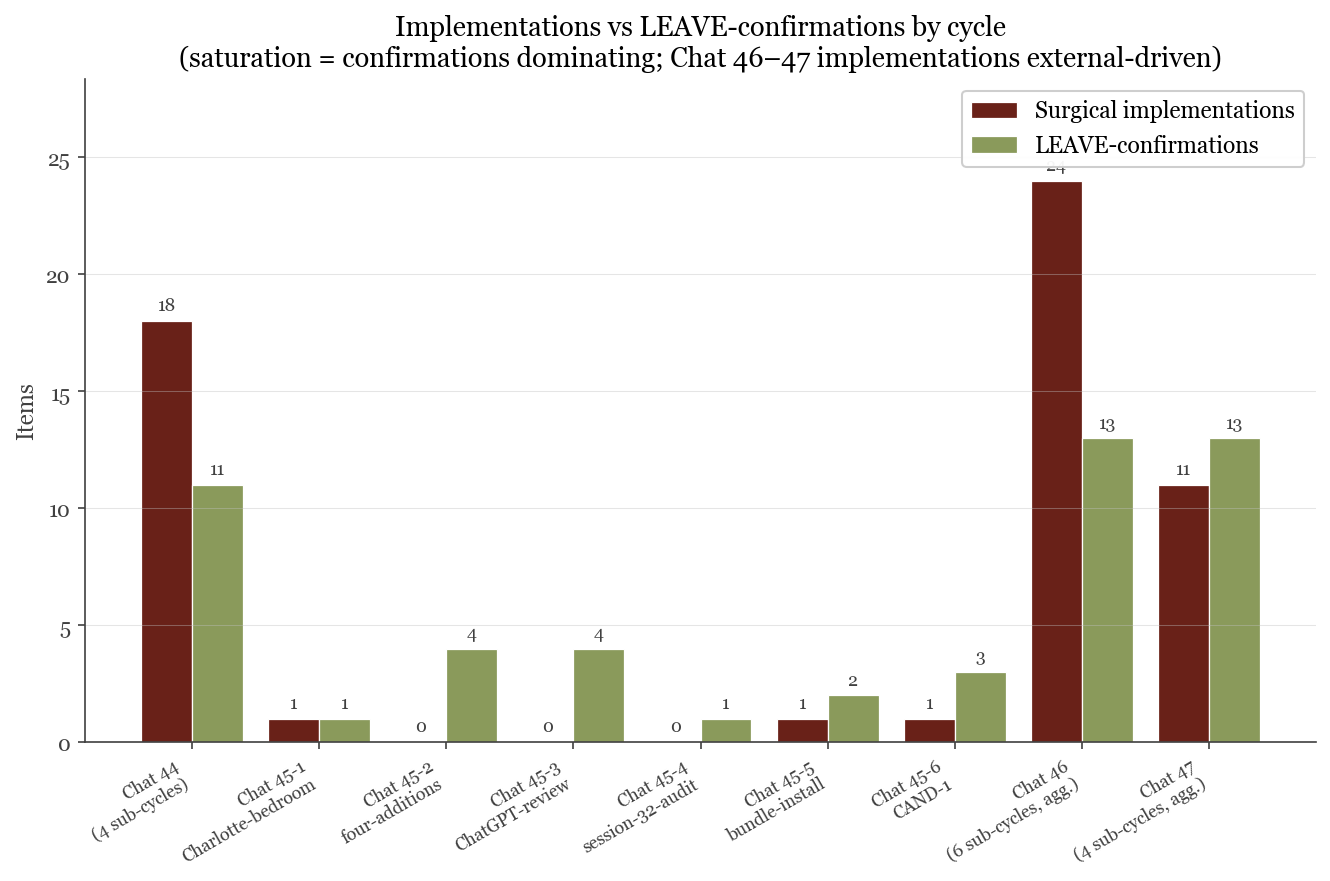
Chat 44 (drafting-shaped) produced 18 implementations to 11 confirmations. Chat 45's six sub-cycles produced 3 implementations to 15 confirmations — the canonical 5:1 saturation ratio. Chats 46 and 47 saw implementation counts spike again, but for a specific reason: the new implementations were largely external-input-driven (audiobook cold-read flags, an external-review pack, the new triplet-meter-pass v0.1 first run) or author-directed (the W2 final halo Ch XI rewrite). They were not audit-saturation outcomes; they were responses to fresh external triggers.
The canonical saturation signal in this window is the Chat 47 fourth-cycle two-stage whole-book editorial pass, which ran the full book-editorial v0.31 framework against the entire manuscript and returned zero surgical implementations. That zero is what the methodology document calls the "pure-LEAVE outcome class": a panel deliberation that produces zero implementations is not a failed audit — it is the protocol working as designed at architectural saturation.
The Chat 47 first-cycle's 8/0 ratification of the author-built W2 final halo chapter rewrite, and the Chat 47 second-cycle's panel-blocking of the chat-advisor's "general trim-candidates LEAVE," both demonstrate the same pattern from the previous compilation: the canon's integrity protecting the manuscript against its own collaborators' over-corrections.
5. Per-machine workload split
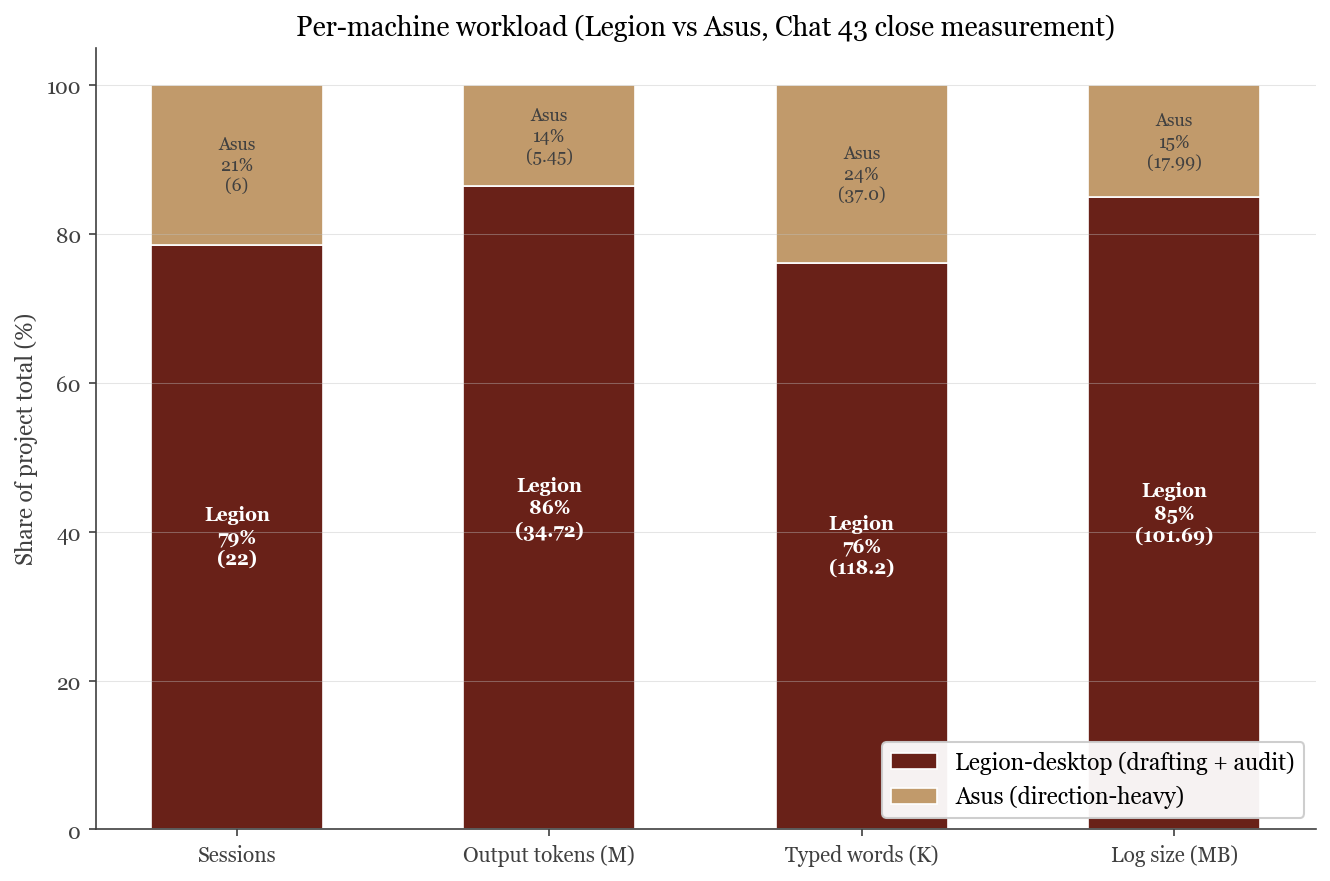
The Code-side production split across two physical machines: a Legion-desktop (at home) and an Asus laptop (mobile / direction-heavy). The two machines have specialized into different roles, visible in the metric ratios. These figures carry forward from the Chat 43 measurement; Code-side re-measurement is calendar-gated to mid-August 2026.
Legion-desktop ran 22 of 28 sessions, produced 86% of Code-side output tokens and 76% of typed words, and accumulated 85% of the per-machine log size. Asus ran 6 sessions but with twice Legion's typed-words density per output-token (0.68% versus 0.34%). The interpretation in the production-stream-metrics document: Legion is the drafting + audit-cycle + execution machine; Asus is the direction-heavy late-stage work-machine. When the writer was on Asus, he was directing more per token of generation; when he was on Legion, the machine was producing more output per word of direction.
The asymmetry matters because it confirms a methodological observation in METHODOLOGY §9.6 — that in-chat communication is most useful in verbose explanatory prose, while Code-session work tightens to compact directives. The two machines reflect two registers of human-machine collaboration: one where the human directs more sparsely against high-volume machine generation (Legion), and one where the human directs more densely against tighter machine output (Asus).
The Chats 44–47 Code-side increment is unmeasured at the time of this compilation. Best estimate: approximately 7–10 additional Legion sessions across the four chats producing roughly 2–3 million additional output tokens and 30,000–50,000 additional typed words. A fresh measurement pass in mid-August 2026 will refine these figures.
6. The token economy
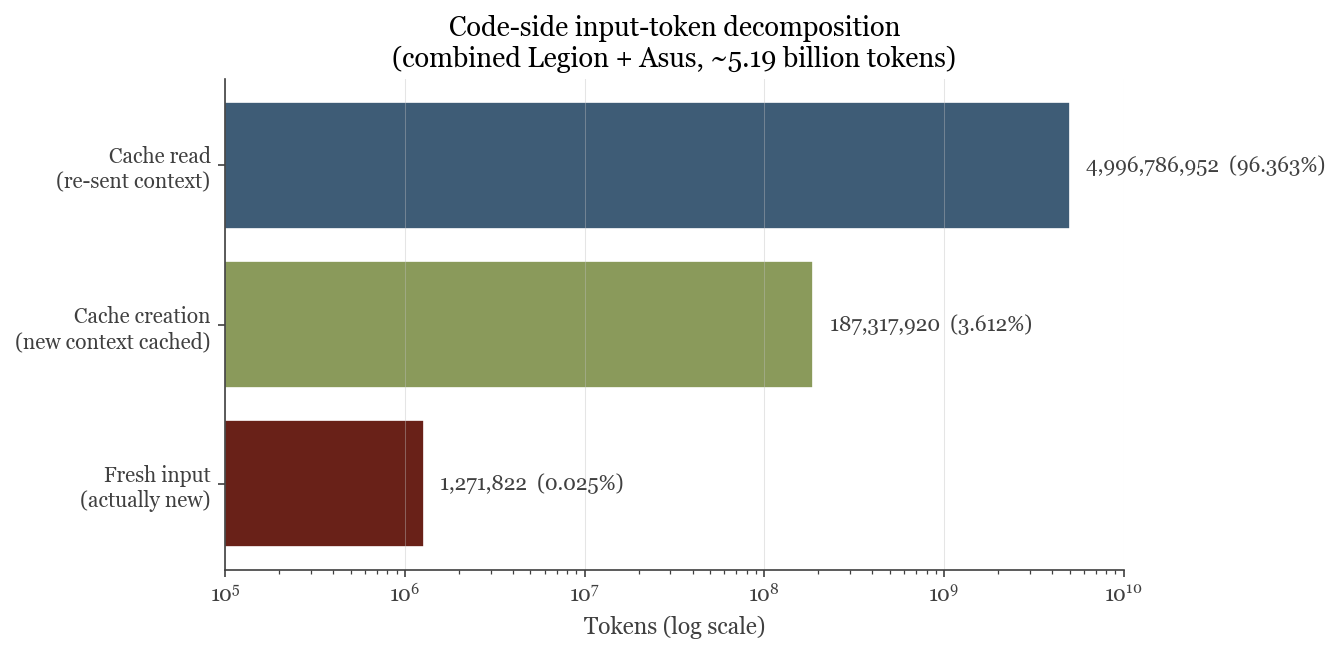
A methodological caveat about what "input tokens" actually means. The Code-side input-token count, summed across both machines at Chat 43 measurement, is approximately 5.19 billion tokens. But the vast majority of that count is not new information — it is cache-read overhead.
96.4% of input tokens are cache-read — the same system context (skill files, tool definitions, prior conversation, file contents) being re-presented to the model each turn at low marginal cost. 3.6% are cache-creation (new context being cached for re-use). Only 0.025% are fresh input — the truly new content each turn.
For "informational input" — what is genuinely new per turn — the relevant figure is the fresh + cache-creation share, approximately 3.6% of total input tokens, or roughly 188 million tokens. For "human-typed words" — the literal text the writer typed into the input box — the relevant figure is 187,237 words at Chat 47 close, of which 155,237 came from queue-operation enqueue events in the Code logs and approximately 32,000 came from chat-side and external-LLM surfaces. These two numbers describe different denominators for any "input rate" question.
The 96.4% cache-read share has its own methodological implication: the model's work on this book is mostly re-reading what the writer has previously made. Each turn the model sees the skill files, the canon, the prior conversation, the manuscript itself. The model's capacity to maintain register across 75,000 words is in part a function of its capacity to keep re-reading what the register is. The cache-read overhead is not waste; it is the substrate that lets the collaboration accumulate without resetting each turn.
7. Manuscript trajectory
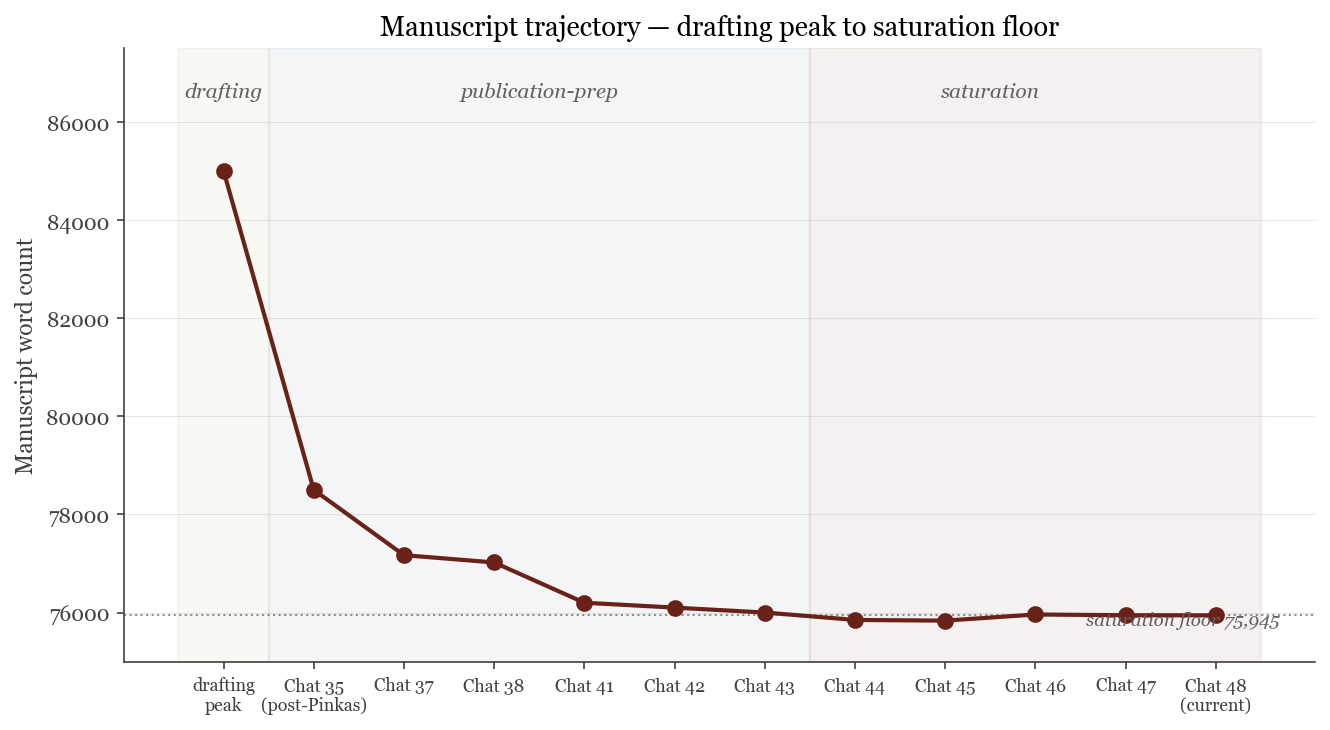
The manuscript itself, plotted across the project's life, traces a curve from a drafting peak of approximately 85,000 words to a publication-prep floor of 75,943 — a net subtractive arc of nearly 10,000 words across Chats 35–48.
The trajectory reveals three phases. The drafting phase (through approximately Chat 32) expanded the manuscript to its peak as Books I–VII were drafted in sequence. The publication-prep phase (Chats 32–43) compressed by approximately 9,000 words as voice-pass cycles, because-pass cycles, model-tell sweeps, and the v12 Improvement Pass landed surgical cuts under panel ratification. The saturation phase (Chats 44–48) settled at the floor, with small fluctuations as architectural insertions and surgical cuts traded against each other within a narrow band of ±150 words around 75,950.
The arc's subtractive character is the method's signature. The book got shorter as it got better. The Master 1 V Compression trio, the order-of-operations rule, the trio-approved-cuts protocol, and the new triplet-meter-pass skill (v0.2 at Chat 47 close) are all specifically designed for subtractive editing. Most contemporary AI-assisted writing increases word count on each pass (the model tends to over-render, expand, gloss, explain). The Vera trajectory shows the inverse: nearly every revision pass produced a shorter manuscript than the one that entered it. The work was in cutting the model's output, not in extending it.
The floor at 75,943 is now where the architecture sits stably. The Chat 47 fourth-cycle two-stage editorial pass, the Chat 46 fourth-cycle whole-book multi-agent editorial pass, the Chat 47 third-cycle triplet-meter-pass v0.1, the Chat 46 fifth- and sixth-cycle audiobook-cold-read fix-passes, the Chat 48 fifth-cycle Phase 2B typographic-register extraordinary-session, and the Chat 48 final close solo-Master 3 S-led extended editorial pass all operated within a ±150-word band of the floor. Three of these returned ZERO manuscript changes; the others returned bounded surgical fixes that sum to small net deltas. The manuscript has converged.
8. Closing observations
Eight charts, eight angles on the same finding. The book is finished. The numbers say so in the language of asymptotes, ratios, and phase changes.
What the metrics do not measure
The metrics in this report describe production. They do not describe quality. The composite score — the method's qualitative-rating instrument — has been deferred to ratification-class calendar-gated re-rating (mid-August 2026 earliest, per METHODOLOGY §9.1). The chat-advisor session 33 holistic read produced a composite of 9.5 (unit-level prose 9.4, architecture 9.6) aligned with three prior external-reader composites of 9.4 / 9.2 / 9.2. Those numbers are informational; they are not part of the production-stream metrics framework this report visualizes.
What the production-stream metrics measure is the cost-of-quality at this curation density: 0.25% survival, ~876× durable-process-record per word of manuscript change at the saturation window, 15.8× durable-process-record-to-manuscript ratio. These describe the labor that produced the book, not the book's reception or literary value.
What the metrics do measure
The metrics measure architectural integrity. Convergence to a stable survival asymptote means the canon has become self-correcting: new edits surface less often, and when they do they are caught more often by the panel's architectural defense than by the audit's surfacing logic. The Chat 47 second-cycle's panel-protected refusal of the chat-advisor's "general trim-candidates LEAVE" recommendation, and the Chat 47 fourth-cycle's zero implementations against the full v0.31 framework, are the canonical instances at this measurement window. The methodological precedents established at Chats 46–47 — Halloran 4-anchoring-site architecture, body-without-conscious-will refrain at 8 canonical body-action sites, cross-file V-line propagation discipline, and the triplet-meter-pass 95/5 operating-target — all extend the canon's defensive coverage.
They also measure documentation discipline. A 15.8× process-residue-to-manuscript ratio, dominated 67% by reviews artifacts, means that the project has produced a complete record of how every load-bearing decision was made. A reader wanting to know why the photograph mystery is closed by argument rather than plot resolution, why the older-women dialogue convergence is structural inheritance rather than stylistic accident, why the line beneath Не я is named at exactly three sites and never again, why the streetlight halo's verification-pulse triplet is signature rather than sediment, why the Auden cadence-echoes stay invisible at the typographic level by design — that reader can retrieve the deliberation that produced the decision. The book's methodology is itself a literary artifact, and the ratio is its size in words.
The methodology's honesty
The colophon's claim — that the machine is new, the habits are older, and they are changing each other — is testable, in some sense, against these numbers. The 0.25% survival ratio is a measure of the older habits doing their work on the new machine: 99.75% of what the machine produced did not survive the writer's discipline. The 15.8× durable-record ratio is a measure of what the new machine produced that the older habits would not have: a complete, queryable record of every decision and every dissent. The two ratios together describe a working relationship: the machine produces volume, the older habits cut the volume into a book, and the documentation discipline keeps the cuts honest by recording why each one was made.
The numbers are not the work, but they are an honest accounting of the work. The book itself is what fell out at the floor of the curve, after 30 million machine-words and 187,000 human-words and 28 Code sessions and 48 chats and 1.20 million words of methodology-residue and 87 catches and 43 cumulative protocol invocations across external-input-fix-protocol, surgical-style-pass, extended-masters-session, triplet-meter-pass, and the new solo-master-led extended-editorial-pass class. That is what produced 75,943 words. The ratio is approximately one to four hundred. The work is in the four hundred.
— compiled from project metrics, May 4 2026 (Chat 48 absolute close)