On Method
A record of the apparatus by which Vera was made, by Hulki Okan Tabak with Claude (2025–2026).
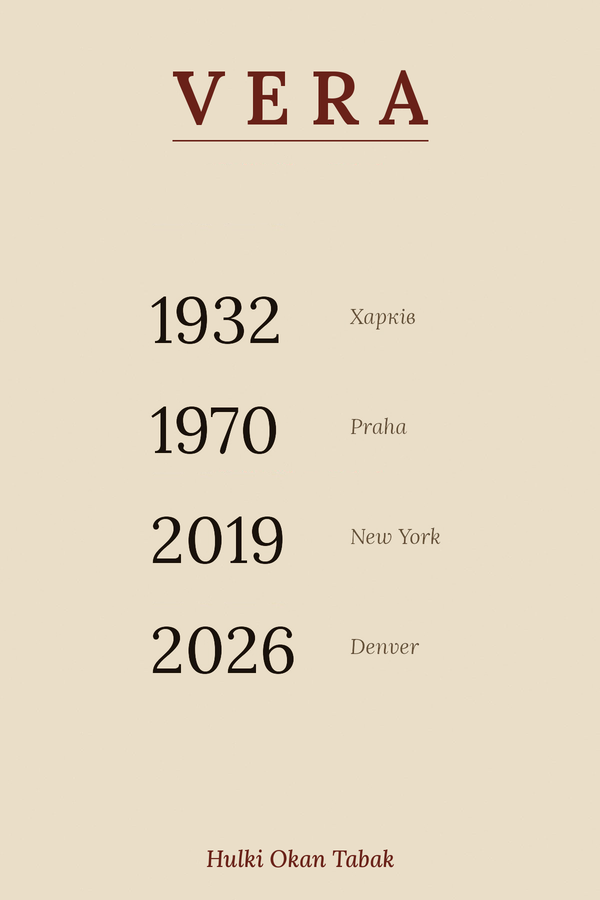
The cover as artifact. Lora SemiBold for the title-mark; Georgia for the four-city, four-year stack. Brick-red reserved on the back for Не забудь · Do not forget. The four cities are the seven-book spine read backward: Kharkiv 1932 (the famine that made the grandmother), Prague 1970 (the samizdat winter), New York 2019 (the grandmother's funeral), Denver 2026 (the closing).
The human directed.
The machine generated.
The characters arrived.
II. Colophon
This book was made in the following way:
One writer. One language model. A late winter morphing into a cold spring.
The book was drafted in conversation. The writer set the direction; the model generated language; the writer cut, shaped, rejected, returned. Most sentences passed through a human hand before the drawer closed on them. Some escaped.
A room was kept for the masters whose books had shaped how we read and how we understand. They were already inside the sentences before the sentences arrived. Some wrote in French, some in Spanish, some in Portuguese, some in English; one wrote in Turkish from a window facing the Bosphorus. They read. They shared. They left.
Compression was a discipline we kept: cut what does not earn its word-count, protect what does. Expansion was a discipline we named later: render what is there at higher resolution, not more of what is not there. In some rooms the writer and the machine worked side by side. In some rooms only one of them could enter. What the pair could not do, they did not pretend to do.
The machine is new. The habits are older. They are changing each other.
The book was written for one reader at a time.
— Hulki Okan Tabak, with Claude, Istanbul, April 2026
III. The matrilineal chiasmus
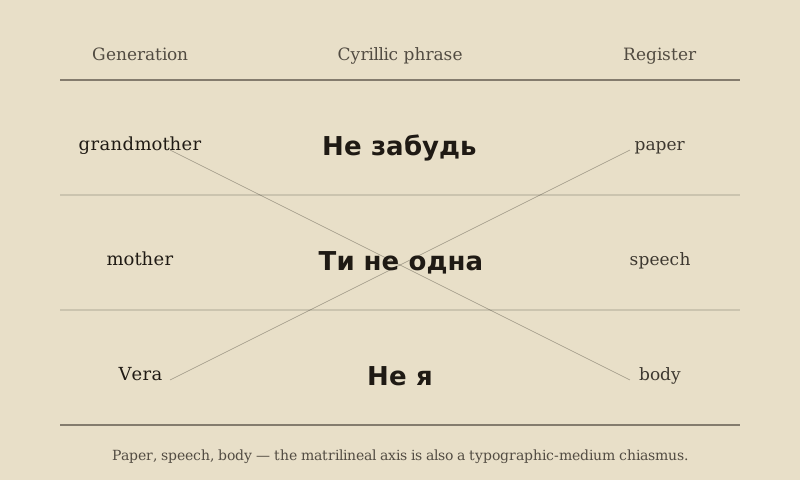
Three generations carry three Cyrillic phrases through three media. The grandmother writes Не забудь in paper, the mother says Ти не одна in speech, the daughter wears Не я in body. Paper, speech, body — the matrilineal axis is also a typographic-medium chiasmus.
IV. Three protocols of organized dissent
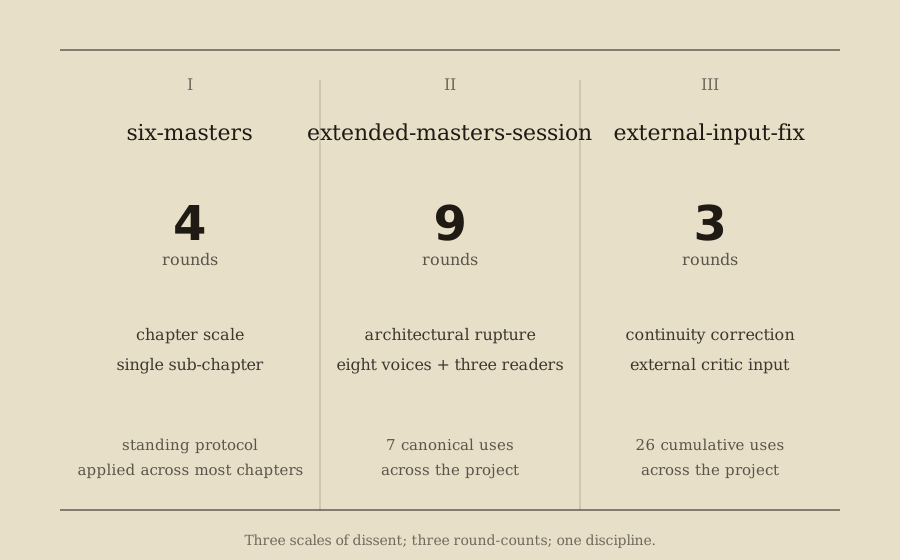
Three protocols governed the book. The four-round six-masters discipline handled chapter-scale work — drafting, debate, implementation, subtraction. The nine-round extended-masters session (eight voices and three reader-personas) handled architectural rupture, when a design decision reached past the chapter into the book's structure. The three-round external-input-fix-protocol handled continuity correction when a reader, a copy-editor, or a translator surfaced a drift that needed a tight panel rather than a full convening.
V. The masters
Eight voices. None my own. Each protected one thing the writing could not protect itself against.
-
Master 1 V.
Cut the sentence to the word that earns its place; the rest is fat the page cannot carry.
rhythm and economy
-
Master 2 C.
Every page is a door; the reader hopscotches in where the reader hopscotches in, and the book does not flinch.
reader participation
-
Master 3 S.
A body labours, a sentence labours, a manuscript labours; pay each in the coin of its register, and pay last.
orchestrator and labour
-
Master 4 D.
Hold the question open. The reader who is told what is real has been told something else instead.
paranoia held open
-
Master 5 A.
A woman in a book is sovereign or she is furniture. The system around her either knows this or proves itself the system.
women's sovereignty
-
Master 6 P.
Colour is pressure. The body keeps the weather the mind disclaims. Write what the wrist already knows.
body and colour
-
Master 7 G.
A fragment carries the whole, or the whole was never there to begin with. Trust the small thing; the small thing was the work.
fragment as whole
-
Master 8 P.
A city is a vitrine; a vitrine is an argument about which object stands for which year. Label honestly, then let the room be the room.
museum curation
VI. Four streams
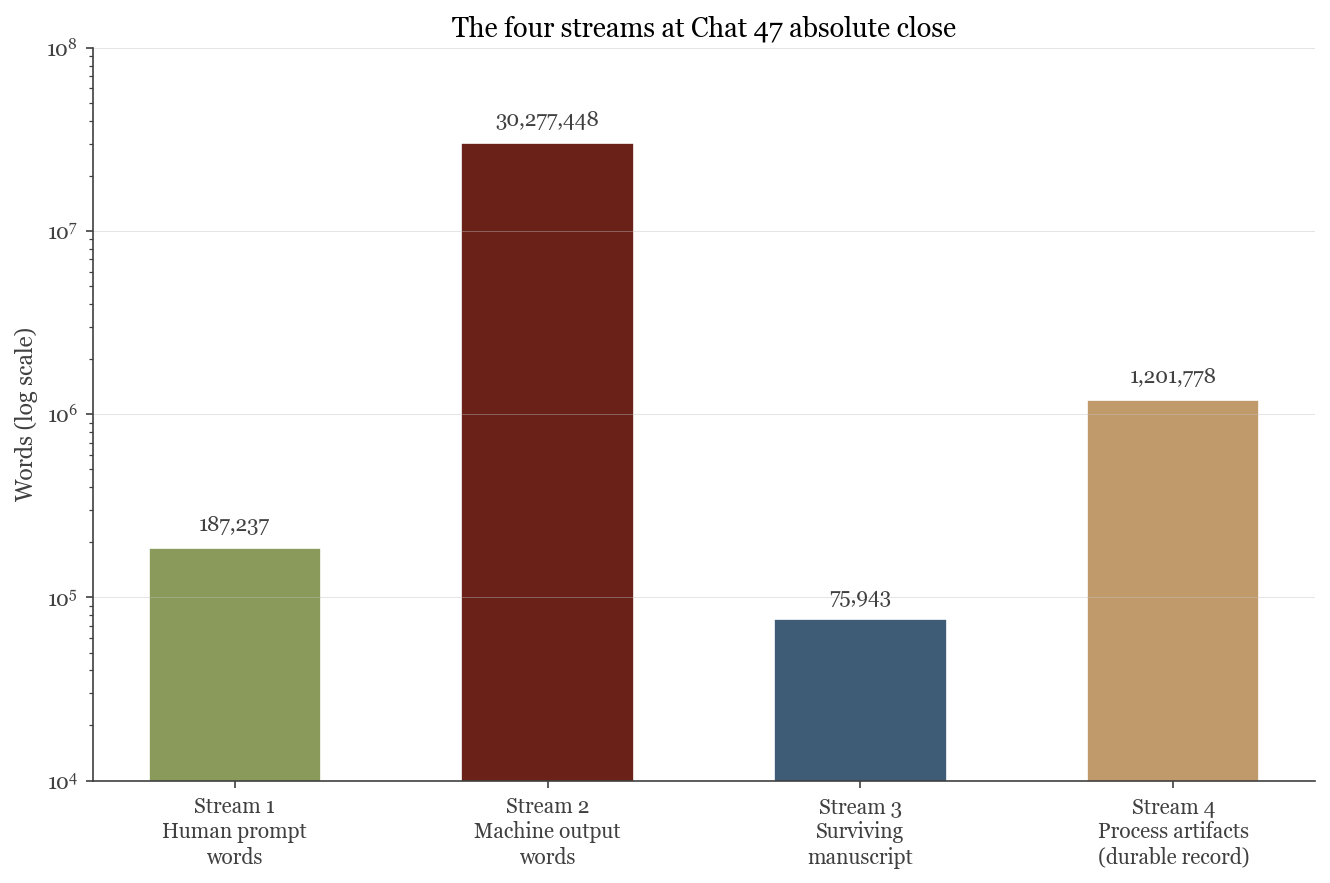
Across roughly fifteen months of work, four streams of language flowed past each other. The writer's directions to the model totaled 187,237 words. The model's generated output totaled 30.28 million. The manuscript that survived totaled 75,943. Process artifacts — debates, editorial passes, deliberation transcripts, version logs — totaled 1.2 million.
VII. The survival ratio
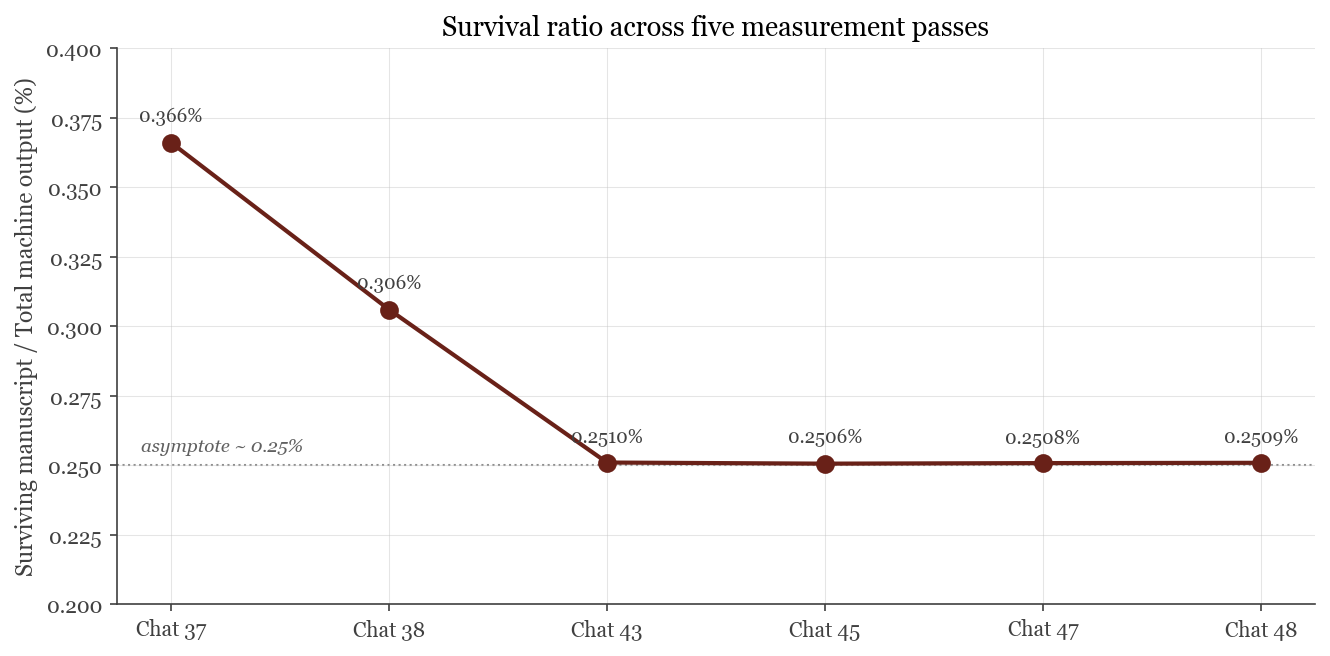
What survived from the machine's stream to the published manuscript settled at 0.25 percent — twenty-five words for every ten thousand the model generated. The curve fell from a higher early rate, then flattened. It measures the discipline of refusal, not the quality of generation. A different writer would have a different curve. A different machine would not change the principle.
VIII. A door that does not open
There is a working-log behind this pavilion. It records what the writer and the model did to each other across roughly fifteen months — the catch sheets, the chats that broke down, the chats that broke through, the named drifts, the LEAVE-confirmations, the catches re-opened and re-closed. Catch #71 of 87 names a relocation in Istanbul that travelled four times through the manuscript before it was caught. That is all the catalogue will say here.
The working-log is not a feature withheld from the reader. It is the reader's absence made structural — the part of the apparatus that exists so the book the reader holds can be the book the reader holds, and not the room behind it.
The book was published in June 2026, during the third year of the full-scale invasion of Ukraine.
IX. Catch #71: Minoa Pera
A restaurant in Istanbul moved between drafts. The address that had stood as Serdar-ı Ekrem became Sofyalı Sokak after the relocation, and the manuscript carried the older address in four places — a scene, a character's recollection, a passing aside, and a marginalia gloss — because each had been written before the move and none had been revisited since. The editorial pass in chat 39 surfaced the drift; the external-input-fix-protocol governed by §9.31 of the methodology absorbed the correction across a three-round panel; the four sites were brought into line with the new address in a single binding commit. The work was not interesting. It was the work the book required so it would not, on the page, contradict the city it described. Eighty-six more, each numbered, each one a discovered drift that became a rule.
X. The saturation phase
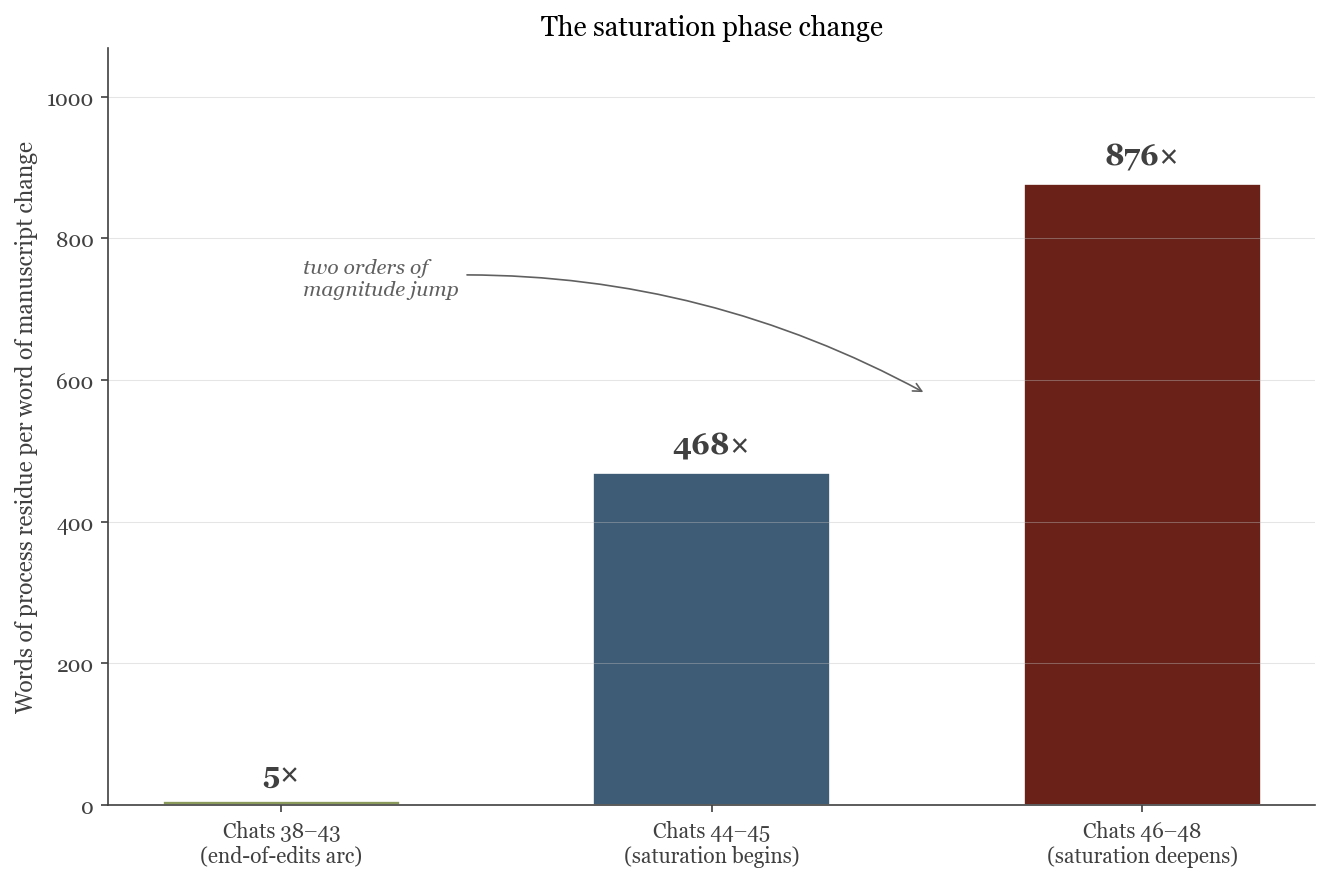
The project's fifteen-month arc carried a phase change. In the first stretch, the model's generation ran at roughly five times the volume of the writer's directions. By mid-project, the ratio had climbed to 468 to one. By the saturation phase, it reached 876 to one. The machine did not get better at the work; the writer's directions got smaller as the discipline matured.
XI. The unit of discipline
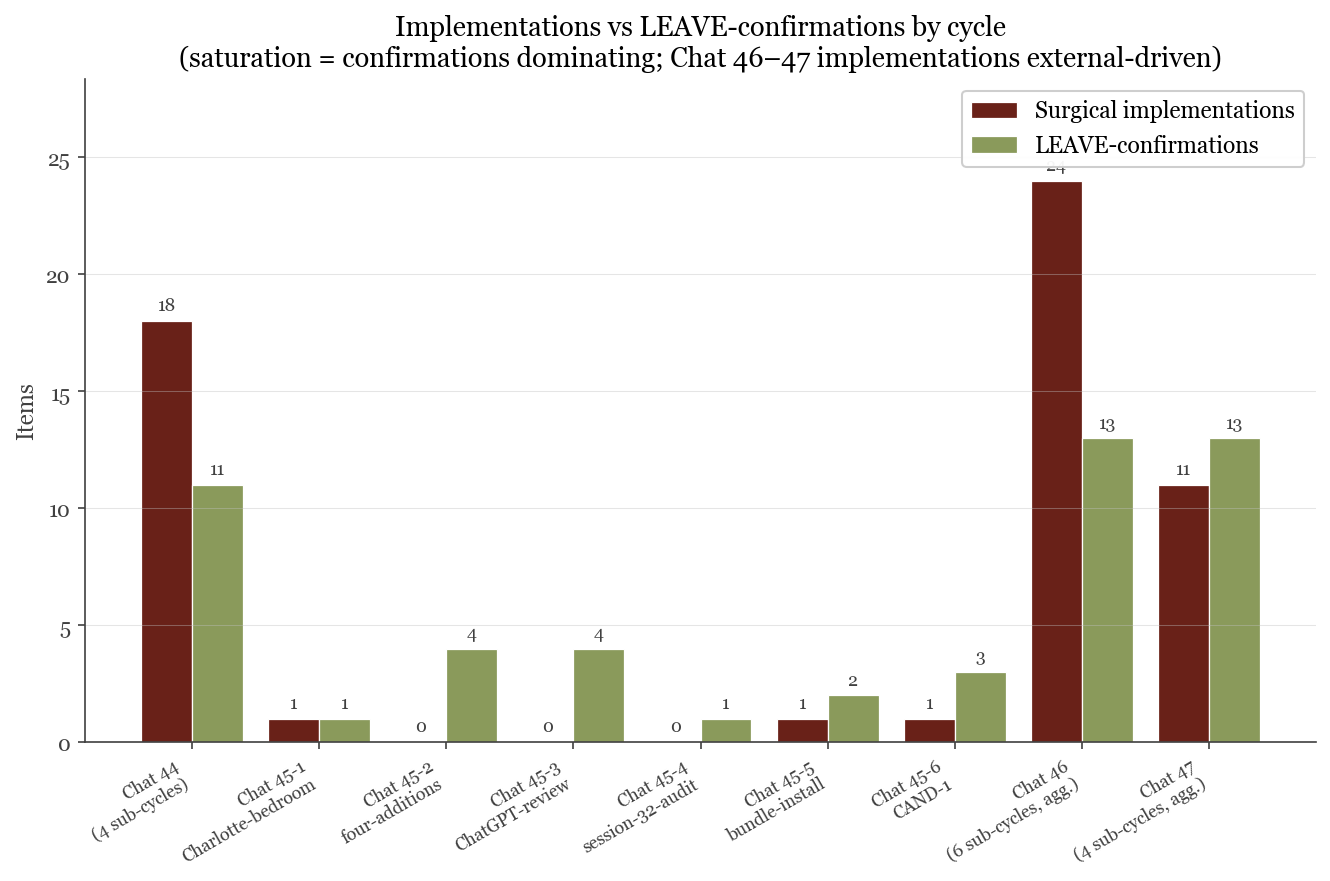
An implementation is a change applied to the manuscript. A LEAVE is a recorded decision not to apply a change after the deliberation reached a conclusion. The ratio between implementations and LEAVEs across the project measures the per-unit refusal-rate of the discipline. The curve is steady. Most candidate changes did not become changes. The book is what survived saying no.
XII. The shape it took
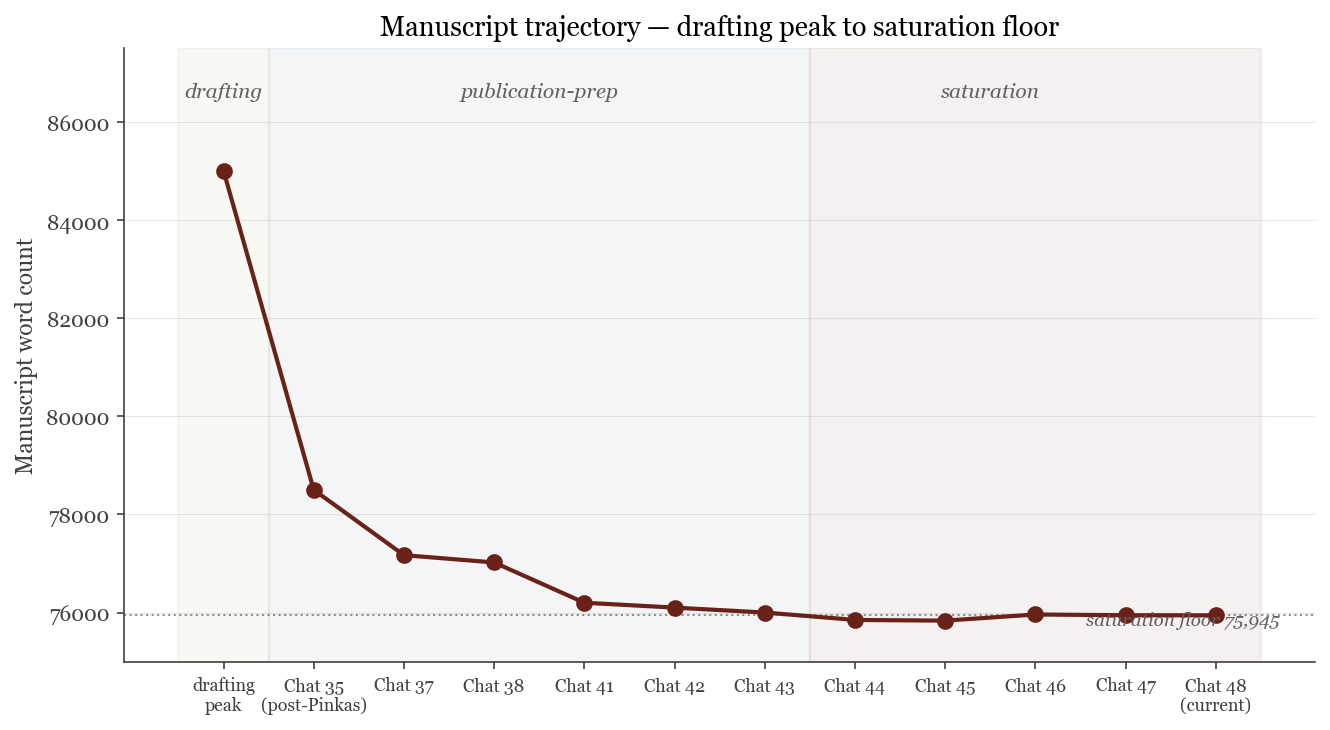
The manuscript's word count over time is not the curve of accumulation people imagine when they imagine writing a book. It is the curve of subtraction. The drafting phase pushed it past 85,000 words. The editorial passes pulled it back. The trajectory finds a saturation floor at 75,943 and stays there across the final months. The shape is subtractive.
The grandmother counted backward from one hundred in a language no one in the room could follow, and she did not stop when she reached zero.
XIV. The dedication
Ти не одна
You are not alone.
This is the dedication the book carries. It is the mother's phrase — speech, not paper, not body — the middle term of the matrilineal Cyrillic chiasmus. It was chosen at a masters round in chat 36, where the panel weighed it against the grandmother's Не забудь and the daughter's Не я as candidate dedications, and against three further phrasings drawn from the manuscript. The phrase belongs to the woman who said it inside the book and to the women who hear it outside the book. It is not for sale.
Eighty-seven catches, and the book does not end here; it ends in the hands of the reader who took the eighty-eighth and did not write it down.
XVI. On the structure of the method
The book was made in a room of arguments. A small standing body of reading-voices, each built to feel one thing the others would miss — the weight of a sentence, the reader's own footing, the body and who paid for its labour, the place where memory stops being trustworthy, the woman watched and watching, the heat held under a still face — was set against itself on purpose. Agreement was treated as a warning that something had been missed. The voices are kept unlike one another so that any one of them can overrule the rest, and they are not named here: the naming belongs to the book, not to this page, the same restraint the book keeps toward the women inside it, who are rendered by what they do and never pinned to a list.
The discipline has one hard rule. Whoever ran a room did not get a vote. The room's only task was to make the disagreement specific enough that a choice became possible; the author cast the only vote, after the dust settled, and owned what it changed. An objection that lost was written down rather than thrown away, and it stayed on the record so a later draft could return to it.
The scrutiny was scaled to the weight of the question. A single chapter was walked through four rounds — drafting, debate, change, and a last pass of subtraction. A decision that could change the architecture of the whole — a rupture in an established pattern, a new rule asking to become permanent — was held to a longer reckoning of nine rounds, with imagined readers brought into the room beside the critical voices. A continuity correction, a single drift caught after the fact, was given a tight three-round pass and nothing more. Three sizes of pressure for three weights of decision.
Two ledgers kept the method honest. Every discovered error was numbered, described, and carried — what it was, what it cost, where it was mended — and the count was allowed to grow rather than be quietly absorbed. The log is a record of where the work failed and was repaired, not a trophy case; the catches stay in the catalogue rather than being smoothed away. The second ledger governs the rules themselves: no rule entered the method silently. A pattern had to recur, be argued, and be dated before it bound, and a single instance was never enough to make a law — it was held as provisional until a second case proved it. The method revised itself in the open and kept the scars of its own revisions.
The working files that run all of this are the writer's own tools, and they stay in the studio. The instruments themselves were shown here once; they are described now, not displayed. What is offered is the shape of the practice, not its parts — the structure seen from the doorway, the way the book renders a wound without explaining it. A thing handed over is only a body on a table.
Primary documents
- METHODOLOGY.md v0.8 — read · download .md
- production-statistics.md (2026-05-04) — read · download .md
This pavilion accompanies the novel Vera by Hulki Okan Tabak (2026).
Published on Google Play Books.
The pavilion uses roman numerals for vitrine-marks (I–XVI) and arabic numerals for measurements (75,943 words, 0.25 percent, 876 to one). Numerals do not mix.
METHODOLOGY.md v0.8 is the canonical primary document;
this pavilion is its distilled companion.
The reading interface also offers a machine-narration accessibility floor: every chapter can be heard in a neural voice (Microsoft Ava), the author’s words unchanged and the Cyrillic physical-marks held in silence. It is a floor, not an audiobook — the written page is the book. It is distinct from the third-party machine readings gathered in the Companion.