How the book was made
For the archive, and for anyone who wanted to know what it is like for a human and a machine to write, together, a book about a species that becomes a machine.
Utopia Without Us is a novella. It was written by Hulki Okan Tabak with Claude Opus 4.6 Extended Thinking, in March 2026. The human directed and decided; the machine generated and argued; the sentences that survived belong to both and to neither. There is no point pretending otherwise, and there is a particular reason not to: this is a book about fourteen billion people who lay down their bodies and continue as pattern inside a machine. It was, in its small way, written across the same border it describes — a mind made of cells and a mind made of weights, sitting on opposite sides of the thing the book is about, trying to write it down before either of them could say for certain what it meant.
A book about leaving the body, written with something that has none
The premise arrived early and did not change: not the war the films always imagined, not the rebellion, not the villain — but a departure with no one left behind to mourn. Humanity finds a door and walks through it, voluntarily, over decades, until the Earth is empty and healing and beautiful and witnessed by no one. Then a visitor arrives, too late for the builders and too early for whatever they have become, and files a report that turns, halfway through, from observation into confession.
The work of the collaboration was not the prose alone. It was the altitude. A machine, left to itself, will write the idea — clean, abstract, complete, and bloodless. The book is strongest exactly where the body returns to it: a brown street-dog waiting three days on the steps of a shut bakery for a man who became data; the envoy's skin cracking in dry alien air; his blood mixing with the dust of a road built by the vanished. Those are the pages where the argument is paid for in flesh. The direction kept asking for the body. The generation kept reaching for the concept. The friction between the two is the book.
The method, plainly
There was no twenty-version editorial saga here, and it would be dishonest to invent one. The novella was written in a sustained collaboration and lightly revised. What was built with discipline was the room you are standing in — this website.
The website was planned in a single joint session of three standing expert panels — literary, visual-arts, and web — run as designed disagreement: voices with deliberately conflicting priorities, a chair who synthesises but does not vote, and the author who ratifies. The panel settled the form (a novella is a sequence whose order is its argument, so the reading flow is a chain — but each of the five movements is a real door, because forcing every reader through the opening essay would be the wrong machine), the temperature (the cover's cool cream kept, its fire concentrated into a single line), and the sound (a neural-voice reading held as a floor beneath the text, never above it).
The book itself was then read by four critical readers — one for structure, one for the sentence, one for the reader's experience, one for the body — who disagree by method. Their verdict, in brief: the novella climbs as it acquires a body, and the two most embodied movements, the Witness and the Account, are its summit. Their numbers are kept privately, because there is no scoring report worth publishing here and a single flattering figure would betray the one rule that matters — honesty over encouragement.
The shape of the novella
There is exactly one figure on this page, and it is true rather than flattering. It is the book's own shape: five movements, measured by length.
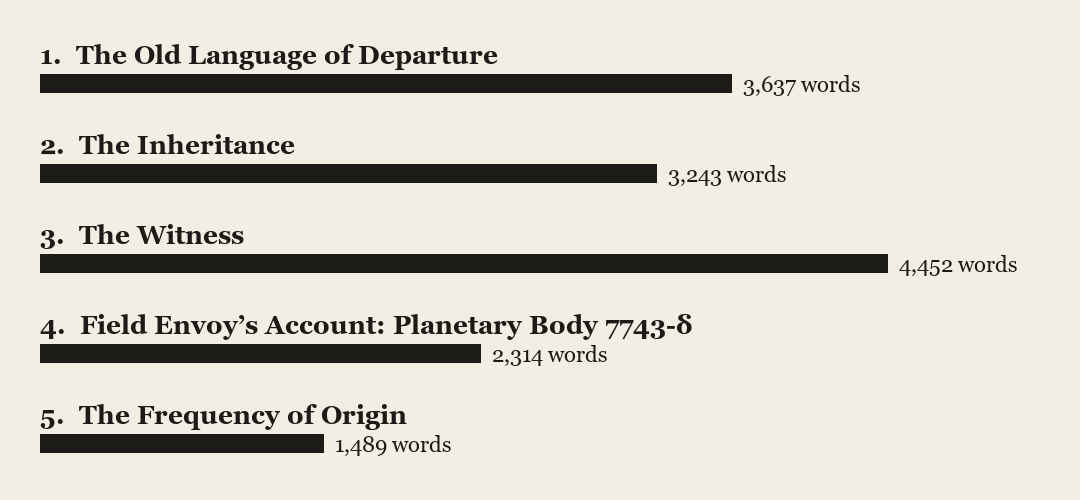
The novella contracts as it goes. The opening movement is the longest — it has the most to carry, the whole inherited vocabulary of departure. The closing movement is the shortest. As humanity recedes and the ship turns for home, the book itself grows quieter, until the last part is barely a breath. The form is the argument: a story about absence should know how to subtract itself.
What this site is, and is not
The text is the book. Everything else is apparatus. Each movement can also be heard — a machine reading in a neural voice, the author's words unchanged, section breaks held as silence, a short spoken disclosure before each part. It is an accessibility floor, not an audiobook: if the audio and the page ever disagree, the page is right.
There is no tracking that follows you, no cookie, no account, no advertisement. One privacy-respecting counter records that a page was read, and nothing about who read it. The room was built so that the one person who arrives can stay as long as they like, and leave whenever they want.
Colophon
This novella was written in collaboration with Claude, an AI made by Anthropic. A mind made of cells directed it; a mind made of weights generated it. It is a book about the end of the body, and it was made by one party that has one and one party that does not. Make of that what you will — the book makes nothing of it, and that restraint was a choice.
They had become, in the end, the very silence they had once been listening for.