Explore 01 · book history and reception
Book on Trial
Serialization, Censorship, and the 1922 Book
Ulysses did not enter the world all at once. It appeared as magazine instalments, became the object of a case against two editors, emerged as Sylvia Beach’s blue Paris book, and later entered a separate U.S. federal customs proceeding as a completed work.
Why follow the objects? “The book was banned” hides the most useful question: what, exactly, was being read and judged—an instalment, a passage, a material edition, or the work as a whole?
01 · orientation
Five bearings before the case opens
The short answers establish the sequence. Every one opens into claim-level evidence and caution below.
01
What reached readers before the book?
Twenty-three Little Review instalments, ending with only the opening of Oxen of the Sun.
Evidence: Readers met a serial before they met one book; Serial form makes interruption visible
02
What was tried in 1921?
The magazine's publication of Nausicaa and its editors—not the completed 1922 book.
03
Who made the 1922 book possible?
Joyce wrote; Sylvia Beach published and organized advance subscriptions; Maurice Darantière printed; late proof correction continued.
Evidence: First edition names a specific material object; Publication day was also a deadline; Beach sought subscriptions to finance the edition
04
Which Ulysses are we checking?
A named witness each time: the 1922 first edition for bibliographic identity and Gutenberg 4300 for open text checks.
Evidence: First edition names a specific material object; A public-domain witness is not a facsimile; The first edition is an event, not a finish line
05
Why does this history matter?
Because instalment, passage, book, and judgment make different units of reading—and different arguments possible.
Evidence: The 1933 case changed the legal unit; The unit of reading changes the argument; Strong counter-reading: censorship is not a master cause
02 · documentary chain
Six objects, not one smooth story
The chain moves from serial to book to judgment. Its arrows mean “next in this bounded exhibition,” not “therefore caused.” Object labels stay visible in text and shape, including in forced-colour use.
| Date | Object type | What happens | Reading consequence | Evidence |
|---|---|---|---|---|
| March 1918 | SERIALMagazine instalment | Telemachus begins in The Little Review | The work enters public circulation in parts. | SRC0032 · Modernist Journals Project: The Little Review, SRC0033 · University at Buffalo Libraries, James Joyce Collection: Ulysses in The Little Review: instalment catalogue V.B.12.a.i |
| September-December 1920 | SERIALMagazine issue | Partial Oxen is the final instalment | The serial stops before the novel is complete. | SRC0032 · Modernist Journals Project: The Little Review, SRC0033 · University at Buffalo Libraries, James Joyce Collection: Ulysses in The Little Review: instalment catalogue V.B.12.a.i |
| 1921 | CASENausicaa magazine publication | Anderson and Heap are convicted | A 100-dollar fine and order to discontinue publication follow. | SRC0034 · New York Public Library: The Little Review: A Magazine of the Arts |
| 2 February 1922 | BOOK1,000-copy Shakespeare and Company edition | The first edition appears in Paris | The evolving work becomes one named material book. | SRC0008 · National Library of Ireland: Ulysses / by James Joyce — first-edition catalogue record, SRC0035 · The Morgan Library & Museum: Publication Day, SRC0036 · The Morgan Library & Museum: Prospectus for the First Edition of Ulysses |
| 6 December 1933 | JUDGMENTCompleted work in a customs forfeiture case | The federal district court admits the book | The whole book, not an isolated instalment, becomes the stated unit of assessment. | SRC0037 · U.S. District Court opinion reproduced by Justia: United States v. One Book Called Ulysses, 5 F. Supp. 182 |
| 7 August 1934 | JUDGMENTAppellate majority opinion with dissent | The Second Circuit affirms | The district result stands, without becoming universal consensus. | SRC0038 · U.S. Court of Appeals opinion reproduced by Justia: United States v. One Book Entitled Ulysses, 72 F.2d 705 |
Linear text equivalent for the six-object documentary chain
March 1918 · SERIAL
Telemachus begins in The Little Review
- Object
- Magazine instalment
- Reading consequence
- The work enters public circulation in parts.
- Evidence
- SRC0032 · Modernist Journals Project: The Little Review, SRC0033 · University at Buffalo Libraries, James Joyce Collection: Ulysses in The Little Review: instalment catalogue V.B.12.a.i
September-December 1920 · SERIAL
Partial Oxen is the final instalment
- Object
- Magazine issue
- Reading consequence
- The serial stops before the novel is complete.
- Evidence
- SRC0032 · Modernist Journals Project: The Little Review, SRC0033 · University at Buffalo Libraries, James Joyce Collection: Ulysses in The Little Review: instalment catalogue V.B.12.a.i
1921 · CASE
Anderson and Heap are convicted
- Object
- Nausicaa magazine publication
- Reading consequence
- A 100-dollar fine and order to discontinue publication follow.
- Evidence
- SRC0034 · New York Public Library: The Little Review: A Magazine of the Arts
2 February 1922 · BOOK
The first edition appears in Paris
- Object
- 1,000-copy Shakespeare and Company edition
- Reading consequence
- The evolving work becomes one named material book.
- Evidence
- SRC0008 · National Library of Ireland: Ulysses / by James Joyce — first-edition catalogue record, SRC0035 · The Morgan Library & Museum: Publication Day, SRC0036 · The Morgan Library & Museum: Prospectus for the First Edition of Ulysses
6 December 1933 · JUDGMENT
The federal district court admits the book
- Object
- Completed work in a customs forfeiture case
- Reading consequence
- The whole book, not an isolated instalment, becomes the stated unit of assessment.
- Evidence
- SRC0037 · U.S. District Court opinion reproduced by Justia: United States v. One Book Called Ulysses, 5 F. Supp. 182
7 August 1934 · JUDGMENT
The Second Circuit affirms
- Object
- Appellate majority opinion with dissent
- Reading consequence
- The district result stands, without becoming universal consensus.
- Evidence
- SRC0038 · U.S. Court of Appeals opinion reproduced by Justia: United States v. One Book Entitled Ulysses, 72 F.2d 705
TEXT
The novel signs its own long making
The retained transcription ends with three cities and the years 1914-1921. It preserves a compact trace of composition across Europe during and after the First World War.
Caution: The terminal signature records places and years; it does not by itself explain what was written or revised in each place.
Sources: SRC0007 · Project Gutenberg: Project Gutenberg eBook 4300: Ulysses
03 · serial object
Before the blue book, a recurring disturbance
A magazine changes the scale of encounter: only part of the work is present, and it arrives inside an editorial and commercial environment. This page links the issue-level witness but does not embed its scan.
HISTRECON
Readers met a serial before they met one book
The Little Review published Ulysses in twenty-three instalments from March 1918 to 1920. Its last instalment, in the September-December 1920 issue, carried only the opening of Oxen of the Sun.
Caution: This is a publication sequence, not evidence that every contemporary reader followed all twenty-three instalments.
Sources: SRC0032 · Modernist Journals Project: The Little Review, SRC0033 · University at Buffalo Libraries, James Joyce Collection: Ulysses in The Little Review: instalment catalogue V.B.12.a.i
INTERPSCHEMA
Serial form makes interruption visible
A serial instalment arrives beside other writing, advertising, dates, and the wait for another issue. Reading the magazine witnesses makes interruption and editorial surroundings part of the encounter, even though it cannot recover any one reader's response.
Caution: A project reading of material form; not a universal claim about historical reception.
Sources: SRC0032 · Modernist Journals Project: The Little Review
04 · two proceedings
Do not collapse 1921 into 1933
The earlier proceeding concerned editors and magazine publication. The later federal case concerned a completed imported book. Different parties, objects, laws, and outcomes require different sentences.
CASE · 1921
Magazine publication
Margaret Anderson and Jane Heap; Nausicaa material; conviction, fine, discontinuance.
JUDGMENT · 1933
Completed imported book
Federal customs forfeiture; work read in its entirety; admission allowed, then affirmed in 1934.
HIST
The 1921 proceeding tried a magazine publication
After The Little Review published the Nausicaa material, editors Margaret Anderson and Jane Heap were prosecuted for obscenity. They were fined a total of 100 dollars and ordered to discontinue publication of the novel.
Caution: The proceeding concerned the editors and a particular magazine issue, not the completed 732-page 1922 edition and not the later federal customs case.
Sources: SRC0034 · New York Public Library: The Little Review: A Magazine of the Arts
HIST
The 1933 case changed the legal unit
In a federal customs case decided on 6 December 1933, Judge John M. Woolsey considered Ulysses in its entirety and allowed it to be admitted into the United States. The Second Circuit affirmed on 7 August 1934 by a divided court.
Caution: This was a federal importation case and affirmance, not a universal repeal of every restriction in every jurisdiction.
Sources: SRC0037 · U.S. District Court opinion reproduced by Justia: United States v. One Book Called Ulysses, 5 F. Supp. 182, SRC0038 · U.S. Court of Appeals opinion reproduced by Justia: United States v. One Book Entitled Ulysses, 72 F.2d 705
05 · the 1922 object
One blue book, made through many hands
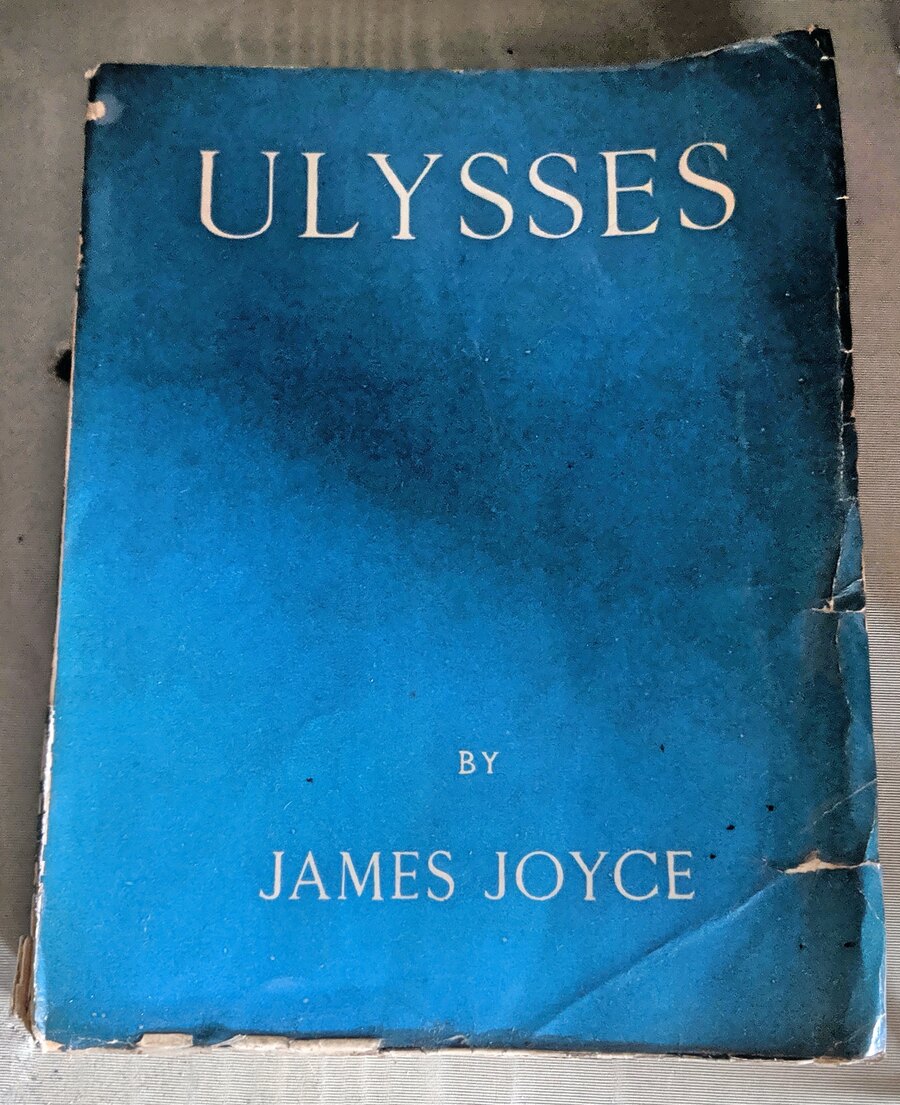
“First edition” is useful only when it names the publisher, printer, place, date, extent, and limitation. The photograph makes the object tangible; it cannot make the text simple or final.

HIST
First edition names a specific material object
The first edition was published in Paris by Shakespeare and Company in 1922, printed for Sylvia Beach by Maurice Darantière at Dijon, limited to 1,000 numbered copies, and issued in 732 pages plus preliminary matter.
Caution: First edition does not mean error-free, unchanged, or typographically identical across every copy.
Sources: SRC0008 · National Library of Ireland: Ulysses / by James Joyce — first-edition catalogue record
HIST
Publication day was also a deadline
Joyce continued correcting proofs through late January 1922. Copies reached him in Paris on 2 February, his fortieth birthday, the date chosen for publication.
Caution: A named publication day does not imply that all copies were bound, distributed, sold, or read at once.
Sources: SRC0035 · The Morgan Library & Museum: Publication Day
HIST
Beach sought subscriptions to finance the edition
Beach solicited subscriptions in advance and offered three versions distinguished by paper and price. The prospectus describes advance orders as necessary to finance the large edition.
Caution: The prospectus was provisional: its autumn 1921 date and 600-page forecast changed before publication.
Sources: SRC0036 · The Morgan Library & Museum: Prospectus for the First Edition of Ulysses
INTERPOPEN
The first edition is an event, not a finish line
The 1922 book gathers the work into one purchasable object, but late proof correction and acknowledged errors make textual authority a history rather than a single immaculate moment.
Caution: This bounded page does not establish a complete genealogy of later editions or adjudicate every variant.
Sources: SRC0008 · National Library of Ireland: Ulysses / by James Joyce — first-edition catalogue record, SRC0035 · The Morgan Library & Museum: Publication Day
06 · edition control
Open access without false finality
The retained Gutenberg file lets every project layer search and check actual wording. That practical authority is different from claiming photographic identity with one first-edition copy—or perfection.
HISTOPEN
A public-domain witness is not a facsimile
Project Gutenberg eBook 4300 is a searchable transcription based on pre-1923 print editions and marked public domain in the United States. It is the project's default open checking witness, not an exact image of the 1922 first edition.
Caution: Exact punctuation, page layout, variant, and non-US reuse claims still require an identified edition and jurisdiction check.
Sources: SRC0007 · Project Gutenberg: Project Gutenberg eBook 4300: Ulysses
Use Gutenberg 4300 for: searchable wording, bounded excerpts, and reproducible open checks.
Name another edition for: page numbers, exact typography, variants, manuscript-to-print change, or copy-specific evidence.
07 · synthesis
Why the arrangement matters
The history is not decoration around the novel. It shows how format and institution decide the scale at which difficult writing can be encountered, interrupted, sold, prohibited, or defended.
INTERPRECON
The unit of reading changes the argument
A magazine instalment, an isolated passage, a 732-page book, and a judicial opinion do not frame the same object. Publication history matters because institutions decide what counts as the unit before they decide what the writing does.
Caution: A project synthesis, not a claim that literary and legal reading use identical standards.
Sources: SRC0032 · Modernist Journals Project: The Little Review, SRC0034 · New York Public Library: The Little Review: A Magazine of the Arts, SRC0008 · National Library of Ireland: Ulysses / by James Joyce — first-edition catalogue record, SRC0037 · U.S. District Court opinion reproduced by Justia: United States v. One Book Called Ulysses, 5 F. Supp. 182, SRC0038 · U.S. Court of Appeals opinion reproduced by Justia: United States v. One Book Entitled Ulysses, 72 F.2d 705
INTERPOPEN
Strong counter-reading: censorship is not a master cause
The evidence shows an evolving work colliding with postal, publishing, and legal institutions. It does not prove that prosecution caused Joyce's experimental form, nor that scandal alone explains the novel's survival.
Caution: Strong counter-reading retained to prevent chronology from becoming unsupported causation.
Sources: SRC0007 · Project Gutenberg: Project Gutenberg eBook 4300: Ulysses, SRC0032 · Modernist Journals Project: The Little Review, SRC0034 · New York Public Library: The Little Review: A Magazine of the Arts
08 · library and method
Sources, rights, status, and known limits
This bounded proof separates text witness, serial archive, institutional history, bibliographic record, judicial opinion, and licensed photograph. It contains no account, form, or project email; the application sends a cookieless, namespaced GoatCounter page-view event and treats provider processing as a separate boundary.
- Architecture
- Site architecture accepted; this Explore proof does not select a permanent framework
- Exact page
- Owner-accepted
- Repository
- Private repository created
- Public release
- Deployed
- Version
- Generated public view v0.2
- Prepared
- 2026-07-20
Known limits
- This is a compact Pilot 5 exhibition, not a complete composition, serialization, censorship, edition, translation, review, or afterlife history.
- The 1921 proceeding is represented through institutional exhibit records; a complete primary trial transcript has not been admitted to this release.
- No Little Review scan is embedded. The linked archive's public-domain statement is US-specific; no worldwide clearance or host-jurisdiction inference is made.
- Project Gutenberg eBook 4300 is a searchable pre-1923 transcription and a public-domain-in-the-USA witness, not an exact 1922 facsimile or universal textual arbiter.
- The single terminal text checkpoint cannot support a complete genetic or revision history.
- The page does not infer that censorship caused Joyce's formal methods.
- The 1933 and 1934 opinions are historical legal sources, not current legal advice or a universal history of obscenity law.
- The page does not yet cover the full British customs, Egoist Press, piracy, smuggling, Random House production, or later-edition sequence.
- The one published photograph is a 2020 image of a museum object; it carries CC BY-SA 4.0 obligations and is not a first-edition facsimile.
- The source repository remains private and the canonical public origin and host privacy boundary are recorded; undocumented provider jurisdiction or retention details remain unknown.
- The exact page has completed simulated review, local validation, explicit owner acceptance, and public deployment; real-user and assistive-technology validation remain separate.
How to read the labels
- TEXT
- Wording or structure verified in the retained public-domain text witness.
- HIST
- Publication, legal, or bibliographic context supported by an identified public source.
- INTERP
- A bounded project reading, not a historical fact, legal conclusion, or only interpretation.
- SCHEMA
- A project ordering or display convention, not a historical object's own category.
- RECON
- A project reconstruction from more than one identified record.
- WINDOW
- A bounded interval rather than an exact date or complete sequence.
- OPEN
- Evidence, rights, or interpretation remains unresolved.
Bounded public source register
Links lead to the named object or institutional record. Rights and cautions travel with the source; a linked page is not silently copied into the project.
SRC0007 · Project Gutenberg
Project Gutenberg eBook 4300: Ulysses
Use: TEXT witness for the terminal composition signature and a searchable reading copy
Locator: retained snapshot lines 32835-32837
Accessed: 2026-07-20
Rights: Project Gutenberg marks the eBook public domain in the USA; jurisdiction review remains required elsewhere; no Gutenberg branding is reused.
Caution: The eBook page says the transcription is based on pre-1923 print editions. It is not an exact first-edition facsimile or a sufficient basis for edition-specific typography.
SRC0008 · National Library of Ireland
Ulysses / by James Joyce — first-edition catalogue record
Use: HIST bibliographic identity of the 1922 Shakespeare and Company first edition
Locator: edition, publication, colophon note, limitation statement, and physical description
Accessed: 2026-07-20
Rights: Linked institutional catalogue record; bibliographic facts are paraphrased; no NLI image is reproduced.
Caution: A catalogue record identifies one edition and copy; it does not establish that every surviving copy is identical.
SRC0032 · Modernist Journals Project
The Little Review
Use: HIST serial overview and access to issue-level witnesses
Locator: journal introduction and issue run
Accessed: 2026-07-20
Rights: Linked scholarly digital archive; no scan is embedded in this local proof.
Caution: The overview compresses a complicated suppression and trial history; issue, court, and bibliographic objects remain distinct.
SRC0033 · University at Buffalo Libraries, James Joyce Collection
Ulysses in The Little Review: instalment catalogue V.B.12.a.i
Use: HIST catalogue support for the 23-instalment run and the partial Oxen of the Sun final instalment
Locator: V.B.12.a.i serial holdings description
Accessed: 2026-07-20
Rights: Linked institutional catalogue; project-authored paraphrase only.
Caution: Catalogue-level evidence does not replace a complete textual collation of all serial and book states.
SRC0034 · New York Public Library
The Little Review: A Magazine of the Arts
Use: HIST institutional account of the Nausicaa prosecution, conviction, fine, and discontinuance order
Locator: item description for The Little Review, vol. 5, no. 11
Accessed: 2026-07-20
Rights: Linked institutional exhibit; short factual paraphrase only; no NYPL image is reproduced.
Caution: The 1921 proceeding concerned the magazine's publication of Nausicaa and its editors; it was not the 1933 federal customs case about the completed book.
SRC0035 · The Morgan Library & Museum
Publication Day
Use: HIST proofing through late January 1922 and arrival of copies in Paris on 2 February 1922
Locator: online exhibition object 072
Accessed: 2026-07-20
Rights: Linked institutional exhibition; short factual paraphrase only; no Morgan image is reproduced.
Caution: Publication-day narrative is not a complete account of composition, financing, printing, binding, distribution, or later corrections.
SRC0036 · The Morgan Library & Museum
Prospectus for the First Edition of Ulysses
Use: HIST subscription financing and the first edition's three paper/price categories
Locator: online exhibition object 066
Accessed: 2026-07-20
Rights: Linked institutional exhibition; short factual paraphrase only; no Morgan image is reproduced.
Caution: The prospectus forecast changed before publication; its planned autumn 1921 date and 600-page extent were not the final outcome.
SRC0037 · U.S. District Court opinion reproduced by Justia
United States v. One Book Called Ulysses, 5 F. Supp. 182
Use: HIST primary legal opinion for the 6 December 1933 customs/forfeiture decision
Locator: 5 F. Supp. 182, especially pp. 182-185
Accessed: 2026-07-20
Rights: Public judicial opinion linked and briefly paraphrased; no legal advice.
Caution: The opinion resolved the federal importation dispute before that court; it did not erase every censorship history in every jurisdiction.
SRC0038 · U.S. Court of Appeals opinion reproduced by Justia
United States v. One Book Entitled Ulysses, 72 F.2d 705
Use: HIST primary legal opinion for the 7 August 1934 affirmance
Locator: 72 F.2d 705-710
Accessed: 2026-07-20
Rights: Public judicial opinion linked and briefly paraphrased; no legal advice.
Caution: The majority affirmed; the decision included a dissent and should not be flattened into universal consensus.
SRC0039 · The Little Museum of Dublin via Wikimedia Commons
Ulysses by James Joyce — first edition, 1922
Use: Later object photograph of a first-edition copy
Locator: Commons file page and original 2399 x 2945 JPEG
Accessed: 2026-07-20
Rights: Photograph by The Little Museum of Dublin, 10 November 2020, CC BY-SA 4.0.
Caution: A 2020 museum photograph of an object, not a 1922 scene, a facsimile of every page, or proof that all first-edition copies share this copy's condition.