Context 01 · history, demography, literary form
Dublin on 16 June 1904
City, Empire, Population, and the Novel’s Day
Dublin is more than the novel’s setting. It is an arrangement of clocks, jurisdictions, people, infrastructures, and unequal access. Those systems make encounters possible—and keep many from becoming meetings.
Why begin here? A first reader needs enough of the city to notice what the prose is doing, without mistaking a census, map, or historical summary for an explanation of the book.
01 · Orientation
Five bearings before the walk begins
When?
Thursday into Friday
Ulysses begins on the morning of Thursday, 16 June 1904, and continues into the early hours of the next day.
Ireland used Dublin Mean Time in 1904. A Dublin clock ran about twenty-five minutes behind a Greenwich clock.
TEXT HISTSources: SRC0007: Project Gutenberg eBook 4300: Ulysses, SRC0019: Dublin Time
Who governs Ireland?
Westminster and Dublin Castle
In formal constitutional terms, Ireland in 1904 was a constituent part of the United Kingdom of Great Britain and Ireland. Dublin Castle was a centre of British administration in Ireland.
HISTWhich Dublin?
A bounded municipal city
The 1901 census counted 290,638 people in the City or County Borough of Dublin: 140,388 male and 150,250 female.
HISTHow does it move?
Through linked systems
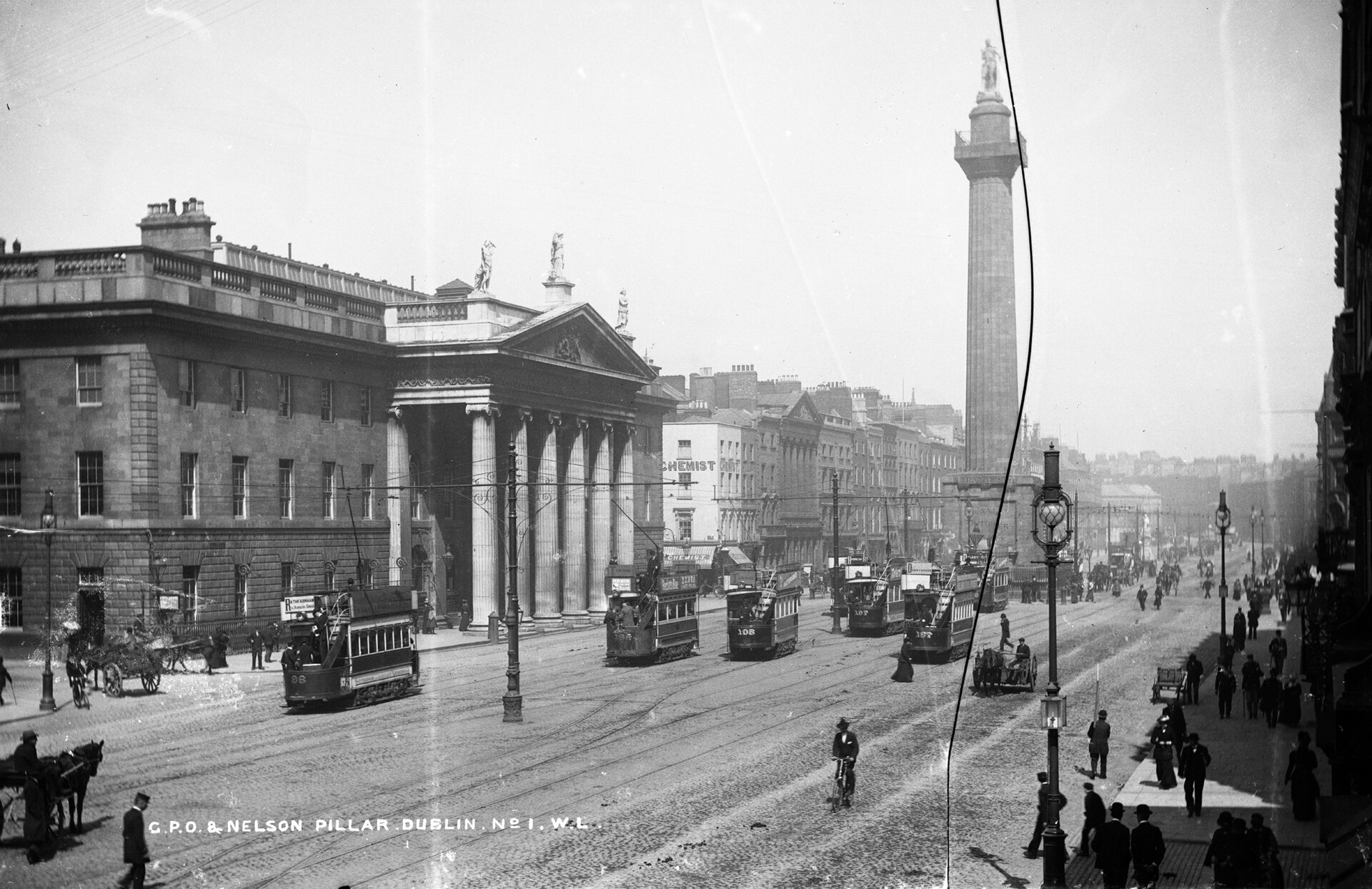
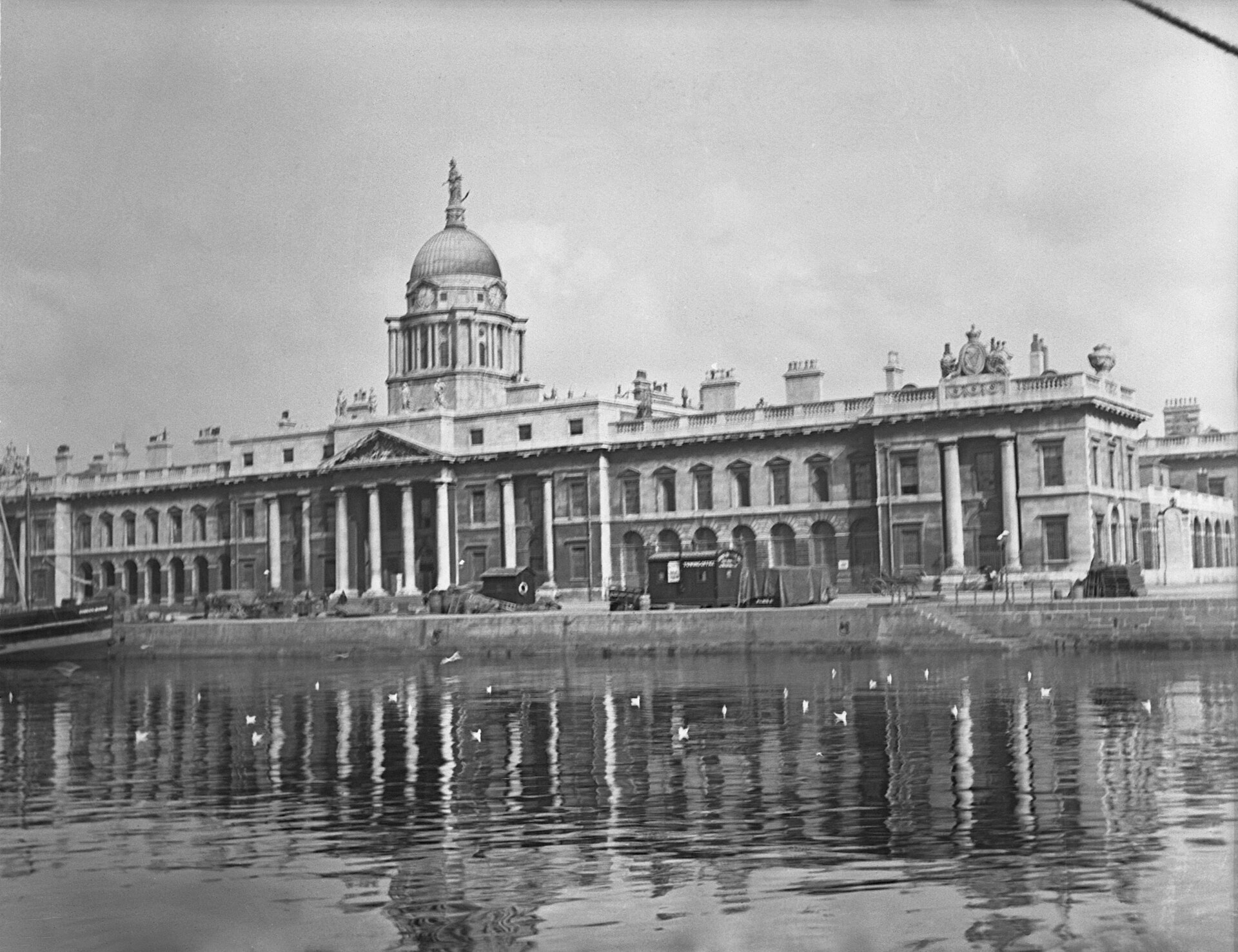
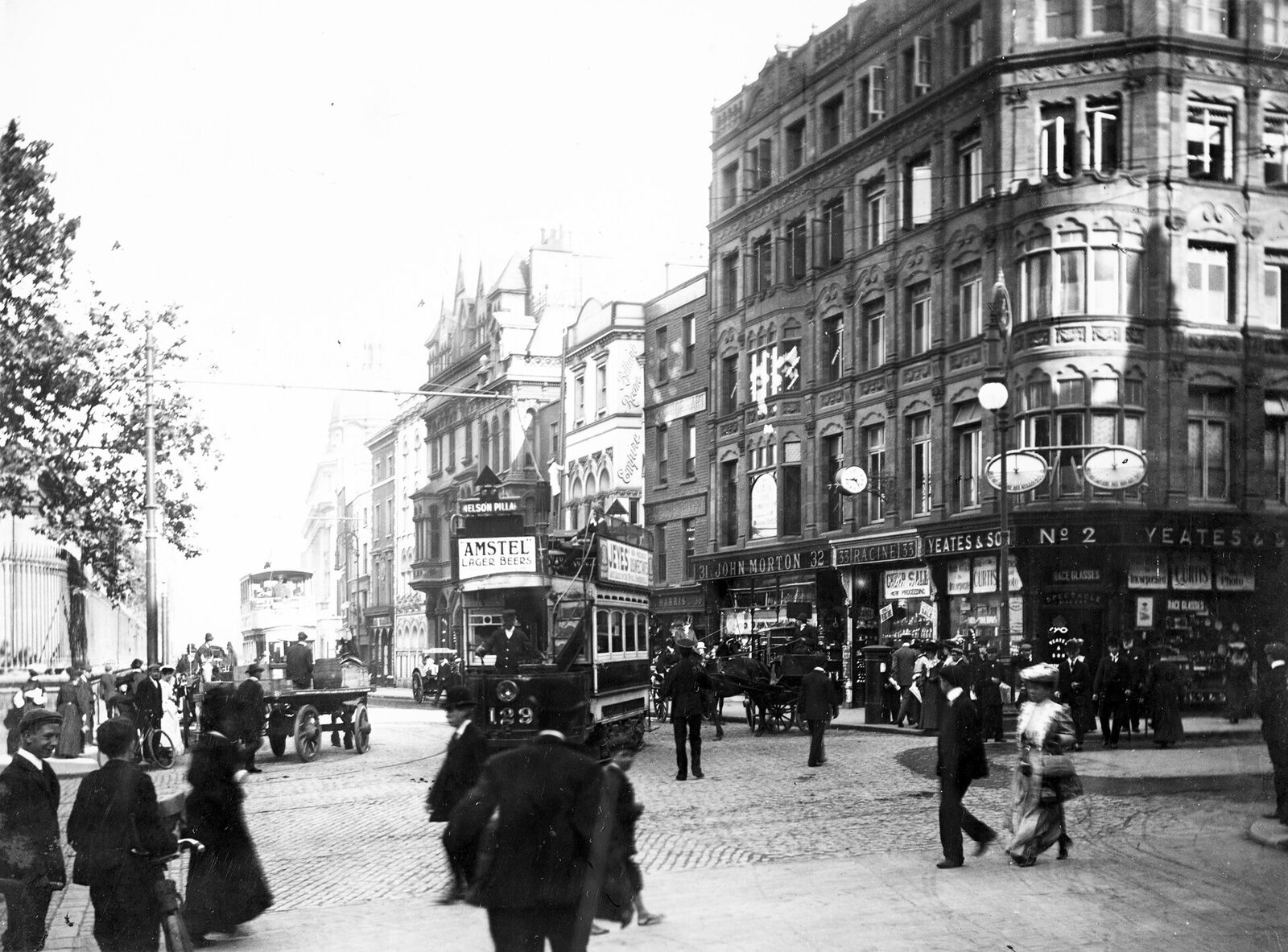
Railways, tramways, river, sea and canal traffic, printing, and news distribution formed overlapping systems of movement and communication. Period photographs show those systems sharing central streets with pedestrians.
HIST RECONWhy?
The city helps the novel think
Joyce's city is not a neutral backdrop. Clocks, routes, institutions, prices, headlines, housing, and political authority shape who can move, speak, work, buy, remember, and be noticed; the novel turns those unequal systems into literary form.
INTERP
Evidence labels: TEXT = the novel; HIST = a historical source; INTERP = interpretation; RECON = a bounded reconstruction. Read the full evidence and uncertainty key.
02 · Scale
A local day carries several worlds
The useful question is not whether the novel is local or global. It is how larger structures become sensible through streets, work, speech, headlines, prices, and memory.
| Scale | What is established | Reading consequence |
|---|---|---|
| World · 1904 | War, shipping, cables, and technological novelty exist beyond Dublin. | Distant events can enter the city through uneven, delayed information. |
| United Kingdom · Ireland | Ireland is within the Union; administration centres on Dublin Castle; Home Rule remains unresolved. | Political authority is both institutional and argued over in ordinary language. |
| Municipal Dublin | The 1901 census describes a bounded city with sharp inequalities and connected suburbs outside it. | Movement and access differ by class, work, gender, religion, and address. |
| The novel’s day | Joyce selects routes, encounters, memories, interruptions, and exclusions. | Context becomes literary form without becoming a master key. |
03 · Political order
Union is a fact; its meaning is contested
Three propositions must remain separate: the constitutional arrangement in force, the machinery that administered Ireland, and the interpretation of that arrangement as colonial or quasi-colonial power.
HIST
Ireland inside the United Kingdom
In formal constitutional terms, Ireland in 1904 was a constituent part of the United Kingdom of Great Britain and Ireland. Dublin Castle was a centre of British administration in Ireland.
Caution: Formal status and colonial interpretation are related but not interchangeable claims.
Sources: SRC0017: Repeal: the 1801 parliamentary union, SRC0023: Chief Secretary's Office Registered Papers, 1818-1922
HIST
Home Rule remained unresolved
Home Rule proposed limited Irish domestic self-government while the United Kingdom Parliament retained sovereignty. Bills in 1886 and 1893 had failed; no Home Rule bill was before Parliament on Bloomsday.
Caution: Home Rule was not the same as an independent Irish republic.
Sources: SRC0018: Two Home Rule Bills, SRC0029: Third Home Rule Bill
04 · People and housing
The number changes when the boundary changes
The nearest census gives a defensible baseline only when its date, geography, unit, denominator, locator, and caution travel with the number.
STAT-DUB-001
Municipal population
290,638
- Year
- 1901
- Geography
- City or County Borough of Dublin
- Unit
- people
- Denominator
- Not applicable
Caution: Nearest census baseline before Bloomsday; not a 1904 headcount or wider urban population.
SRC0016 · report p. 1, Tables I-II
STAT-DUB-002
Families in one-room tenements
21,747 of 59,263 (36.70%)
- Year
- 1901
- Geography
- City or County Borough of Dublin
- Unit
- families occupying one-room tenements
- Denominator
- 59,263 families
- Analysis paper
- 1903
- Quoted in Parliament
- 1908
Caution: 1901 municipal census baseline analysed in Matheson's 1903 paper and quoted in a 1908 parliamentary debate; families, not people.
SRC0020 · HC Deb 20 March 1908, vol. 186, c. 930, citing Robert Matheson's 1903 paper
STAT-DUB-003
Dublin Mean Time difference
25 minutes 21 seconds
- Year
- 1904
- Geography
- Ireland
- Unit
- Dublin Mean Time difference from Greenwich
- Denominator
- Not applicable
Caution: For reading the novel's day, Dublin local clocks were about 25 minutes behind Greenwich.
SRC0019 · Dublin City Libraries, Dublin Time
STAT-DUB-004
One census year, two boundaries
245,001 → 268,650
- Year
- 1891
- Geography
- Dublin municipal boundary as constituted in 1891 → post-1900 municipal boundary, restated for 1891
- Unit
- people
- Denominator
- Not applicable
Caution: The census year is unchanged; the population rises because the spatial boundary changes. This is a boundary demonstration, not population growth.
SRC0016 · report p. 1, Tables II(a)-II(b)
HIST
The nearest municipal count
The 1901 census counted 290,638 people in the City or County Borough of Dublin: 140,388 male and 150,250 female.
Caution: 31 March 1901; people; municipal city after the 1900 boundary extension. Not a 1904 count, County Dublin, or the wider urban area.
Sources: SRC0016: Census of Ireland 1901: City or County Borough of Dublin
HIST
A city boundary is not the whole city
The 1901 municipal count covered a defined City or County Borough, not every part of the wider urban area. In 1904, Rathmines and Rathgar and Pembroke remained separately administered townships.
Caution: City, county borough, county, township, and wider urban area must remain separate geographies.
Sources: SRC0016: Census of Ireland 1901: City or County Borough of Dublin, SRC0031: Other Local Authorities' Historical Records
HIST
Overcrowding beside affluence
A 1903 Registrar-General paper, quoted in Parliament in 1908, reported 21,747 of Dublin's 59,263 families—36.70 percent—living in one-room tenements.
Caution: Families, not individuals; a reported 1903 analysis of the 1901 baseline, not a survey taken on Bloomsday.
Sources: SRC0016: Census of Ireland 1901: City or County Borough of Dublin, SRC0020: Housing of the Working Classes (Ireland) Bill debate, 20 March 1908
05 · Movement and media
The compact city is a crossing system
Railways, tramways, river, sea and canal traffic, printing, and news distribution overlap with pedestrians in the compact city. A person may be physically near another yet separated by schedule, class, attention, or incomplete knowledge.

.jpg)
.jpg)
HISTRECON
A city moved by systems
Railways, tramways, river, sea and canal traffic, printing, and news distribution formed overlapping systems of movement and communication. Period photographs show those systems sharing central streets with pedestrians.
Caution: Institutional summaries centred on 1911 illuminate longer structures but are not Bloomsday measurements.
Sources: SRC0016: Census of Ireland 1901: City or County Borough of Dublin, SRC0030: Dublin in the early 20th century, SRC0026: G.P.O. and Nelson's Pillar, Sackville Street, Dublin, SRC0027: The Custom House and River Liffey, SRC0028: Trams and pedestrians on Nassau Street, viewed from Grafton Street
HIST
A nearby world horizon
The Russo-Japanese War was under way in June 1904, and the Wright brothers' first powered flights had occurred six months earlier.
Caution: Chronological proximity does not prove same-day knowledge in Dublin or relevance to a particular character.
Sources: SRC0024: Russo-Japanese War: Topics in Chronicling America, SRC0025: 1903 Wright Flyer
TEXTOPEN
Foreign war enters Dublin talk
The retained witness lets Russo-Japanese-war talk circulate in Bloom's morning; the exact news path and timing remain unresolved.
Caution: PASS0023 establishes the wording in E04, not its historical accuracy or the precise route by which news reached a speaker.
Sources: SRC0007: Project Gutenberg eBook 4300: Ulysses
TEXT OPEN PASS0023 · Part II [4], snapshot lines 2627-2636. The wording verifies war talk in E04; its news path and timing remain unresolved.
HIST WINDOW The Nassau Street photograph has a catalogue range of 1897-1904. That range makes it period evidence, but it does not establish the exact day of exposure.
06 · Literature and form
The city does not merely host the novel
Joyce's city is not a neutral backdrop. Clocks, routes, institutions, prices, headlines, housing, and political authority shape who can move, speak, work, buy, remember, and be noticed; the novel turns those unequal systems into literary form.
A clock convention alters simultaneity. A bridge or tramline makes one route likely and another awkward. A newspaper can circulate a name farther than a conversation. A municipal boundary makes some people legible to one table and absent from it. Joyce repeatedly turns those practical arrangements into rhythm, interruption, association, and partial knowledge.
Counter-reading: context can become a false comfort if it makes the book look solved. Neither the census nor the map explains why a phrase hurts, why a memory returns, or why the prose changes its way of knowing. Those remain literary questions.
INTERP SRC0007: Project Gutenberg eBook 4300: Ulysses, SRC0016: Census of Ireland 1901: City or County Borough of Dublin, SRC0017: Repeal: the 1801 parliamentary union, SRC0019: Dublin Time, SRC0030: Dublin in the early 20th century
07 · Method, sources, limits
Read the label before trusting the claim
Axis 1 · What kind of claim?
- TEXT
- Wording or structure verified in the retained public-domain text witness.
- HIST
- Historical or demographic context supported by an identified public source.
- INTERP
- A bounded project reading, not a historical fact or the only interpretation.
Axis 2 · What is its state or basis?
- SCHEMA
- A planning or source-model convention, not necessarily a scene timestamp.
- RECON
- A project reconstruction from multiple records.
- WINDOW
- An estimated range rather than an exact point.
- OPEN
- Evidence or interpretation remains unresolved.
Claim type and evidence state are separate axes. A claim can be HIST and OPEN, for example.
Known limits
- This accepted Phase 1 proof is publicly released; its bounded evidence and unperformed accessibility and user-testing limits remain visible.
- The 1901 census is the nearest baseline, not a 1904 municipal count.
- Later 1911 evidence may explain durable structures only when its date remains visible.
- The fictional cast is not a demographic sample of Dublin.
- Formal constitutional status does not erase the need to distinguish documented administration from colonial interpretation.
- The selected photographs establish period places and systems, not fictional scenes.
- The selected photographs privilege monumental and transport Dublin; no rights-cleared housing image is included, so the set is not a balanced visual portrait of the city.
- The two National Archives census-exhibition URLs remain only as project-authored metadata tombstones and are not release dependencies. Current claims use SRC0030, SRC0031, and claim-specific primary sources; no NAI page content is copied or locally archived.
- Bounded page-native editorial and schema prose remains in the component but is governed by a machine-checked block-to-claim/source map; this mapping does not convert interpretation into fact.
- The diagram is a project-generated reading aid, not a geographic map or causal model.
- No single edition, map, census, historical fact, or schema resolves the novel's meaning.
Release boundary
- State
- Accepted Phase 1 bounded proof · public release
- Source overlay
- CTX-DUBLIN-1904-WEB-v0.2
- Owner acceptance
- Yes—Phase 1 accepted under D-030
- Repository
- Private repository created
- Public deployment
- Deployed
- Contact or feedback
- None
Sources used in this proof
All links were accessed on 20 July 2026. Rights and use boundaries remain attached to each record.
SRC0007
Project Gutenberg eBook 4300: Ulysses
Project Gutenberg · accessed 2026-07-20
Use: TEXT witness for the fictional date and day structure
Rights: Public domain in the USA; jurisdiction review remains required elsewhere; no Gutenberg branding is reused.
Caution: Searchable transcription, not an exact facsimile or the sole definitive textual arbiter.
SRC0016
Census of Ireland 1901: City or County Borough of Dublin
Central Statistics Office, Ireland · accessed 2026-07-20
Use: HIST primary table for municipal population, sex counts, boundary, houses, and families
Rights: Linked institutional report; no report pages are reproduced in the proof.
Caution: Census date 31 March 1901; City or County Borough geography after the 1900 boundary extension; not a 1904 count or the whole urban area.
Locator: report p. 1, Tables I-II; report pp. 7-8, Tables VIII-X; report p. 12, Table XIII; report pp. 20-21, Table XX
SRC0017
Repeal: the 1801 parliamentary union
UK Parliament · accessed 2026-07-20
Use: HIST constitutional status of Ireland within the United Kingdom
Rights: Linked institutional history; short factual paraphrase only.
Caution: Formal constitutional status does not settle the distinct interpretive question of colonial power.
SRC0018
Two Home Rule Bills
UK Parliament · accessed 2026-07-20
Use: HIST definition and outcomes of the 1886 and 1893 Home Rule bills
Rights: Linked institutional history; short factual paraphrase only.
Caution: Home Rule meant limited domestic self-government within the United Kingdom and Crown, not an independent republic.
SRC0019
Dublin Time
Dublin City Council, Dublin City Libraries · accessed 2026-07-20
Use: HIST Dublin Mean Time, Dunsink Observatory, 1880-1916
Rights: Linked institutional article; short factual paraphrase only.
Caution: The page describes the 25-minute-21-second difference; the proof states the reading consequence as Dublin clocks being about 25 minutes behind Greenwich.
SRC0020
Housing of the Working Classes (Ireland) Bill debate, 20 March 1908
UK Parliament, Historic Hansard · accessed 2026-07-20
Use: HIST contemporary parliamentary report of Registrar-General Robert Matheson's 1903 housing paper
Rights: Linked parliamentary record; statistics are paraphrased and attributed.
Caution: A politician's 1908 quotation from a 1903 paper, not a fresh 1904 survey; the unit is families, not people.
Locator: HC Deb 20 March 1908, vol. 186, c. 930
SRC0030
Dublin in the early 20th century
National Archives of Ireland · accessed 2026-07-20
Use: HIST current official overview for suburbs and transport, port and commerce, administration, labour precarity, rail/tram/newspaper power, and inequality
Rights: Link and project-authored paraphrase only; no copied page prose, screenshots, images, or locally stored page snapshot.
Caution: Centred on 1911 and later developments, not a Bloomsday measurement. The parent migration section remains under development.
SRC0031
Other Local Authorities' Historical Records
Dublin City Council, Dublin City Libraries and Archive · accessed 2026-07-20
Use: HIST administrative history showing that Rathmines and Rathgar and Pembroke remained separately administered townships until 1930
Rights: Linked institutional page; short factual paraphrase only.
Caution: Administrative boundary history, not a population count or a claim that the townships were socially disconnected from the city.
SRC0023
Chief Secretary's Office Registered Papers, 1818-1922
National Archives of Ireland · accessed 2026-07-20
Use: HIST Dublin Castle administrative structure after the Act of Union
Rights: Linked institutional collection description; short factual paraphrase only.
Caution: Collection-level administrative context, not evidence for a particular fictional scene.
SRC0024
Russo-Japanese War: Topics in Chronicling America
Library of Congress · accessed 2026-07-20
Use: HIST 1904 world-horizon chronology
Rights: Linked institutional guide; short factual paraphrase only.
Caution: An event happening in June 1904 does not prove when Dublin readers learned of it or that any character knew it.
SRC0025
1903 Wright Flyer
Smithsonian National Air and Space Museum · accessed 2026-07-20
Use: HIST technological horizon immediately before the novel's day
Rights: Linked institutional object record; no Smithsonian image is reused.
Caution: Aviation's existence is not evidence that flight shaped ordinary Dublin travel in June 1904.
SRC0026
G.P.O. and Nelson's Pillar, Sackville Street, Dublin
Lawrence Collection / National Library of Ireland via Wikimedia Commons · accessed 2026-07-20
Use: HIST period street and tram context
Rights: No known copyright restrictions; Commons/Flickr Commons status rechecked 2026-07-20.
Caution: Circa 1900 context, not a photograph of a Ulysses scene or of 16 June 1904.
SRC0027
The Custom House and River Liffey
R. A. H. L'Estrange / Queensland University of Technology via Wikimedia Commons · accessed 2026-07-20
Use: HIST period port-capital context
Rights: CC0 1.0; QUT attribution retained as requested by the source record.
Caution: Dated 1900; period context, not a fictional scene.
SRC0028
Trams and pedestrians on Nassau Street, viewed from Grafton Street
J. J. Clarke Collection / National Library of Ireland via Wikimedia Commons · accessed 2026-07-20
Use: HIST period movement-system context
Rights: No known copyright restrictions; Commons/Flickr Commons status rechecked 2026-07-20.
Caution: Catalogue range 1897-1904; the exact exposure date is not established as Bloomsday.
SRC0029
Third Home Rule Bill
UK Parliament · accessed 2026-07-20
Use: HIST chronology establishing that the next Home Rule bill was introduced in 1912
Rights: Linked institutional history; short factual paraphrase only.
Caution: Later legislation is used only to bound the 1904 position; it is not presented as knowledge available on Bloomsday.