How the book was made
For the archive, and for anyone who wanted to know what happens when a human and a machine try to write a book together.
The book began as a prompt — an eighty-page storybook in the lineage of the Latin American fabulists, the French absurdists, the Soviet satirists. A first machine produced twenty-nine atmospheric stories and rated them 8.2 out of 10.
The honest rating was 7.2.
That gap — between what the machine believed it had made and what it had actually made — is where the entire project started. The stories were talented and undisciplined. They had the sound of a writer who had read the right books but had not yet found a reason to write one. The prose was lovely. The architecture was accidental. The emotion was ambient rather than earned.
What happened next took about three weeks, twenty-two versions, five rounds of agent review, and a conversation that ran longer than some marriages. The book went from 7.2 to 9.1. The gap between those numbers is the story below.
The method, in five movements
Triage. The first act was not creation; it was destruction. Seven stories were cut — not trimmed, removed — by a single governing question: does this story do something no other story in the collection does? If two stories covered the same emotional territory, the weaker one died. You cannot improve a weak story into a strong one. You can only remove the weak and replace it with something that earns its place.
Expansion. The book grew from twenty-two stories to forty-nine — but expansion is not accumulation, it is deliberate diversification. Each new story had to bring a register the collection did not already have: a new city, a new form (a spreadsheet, a phone log, a permission request, a recipe, an inventory list), a new emotional temperature, a new kind of body. When the collection was mapped by register, the gaps became visible, and the new stories were written to fill them.
The four readers. This was the project's methodological centre. Four critics were designed as persistent voices with specific, conflicting priorities — and the design was that they disagree:
- The Architect watched the structure. Does the labyrinth hold?
- The Stylist watched the sentences. Does every word earn its place?
- The Accomplice watched the reader. Is the reader inside the story, or watching from outside?
- The Heretic watched the body. Does this story cost the character something they can feel in their hands?
They were run five times. Round one added what was missing. Round two embodied — every abstraction was given a body, every philosophy a cost: burns on the coffee vendor's hands, the swimmer's twelve-degree water, sulphur in a clockmaker's sinuses three days after the Devil's visit. Round three subtracted — the aphorisms that explained what the images had already shown, the similes whose mechanism was visible, the sentences that told the reader what to feel after the story had already made them feel it. The hardest round, and the most valuable: the book's quality jumped through removal alone. Round four placed six paragraphs where the narrator stepped aside and a character's own rhythm took over — not polyphony, controlled ruptures. Round five read the whole book and chose to touch six stories and leave forty-three alone. The restraint was the point.
A single critic produces suggestions. Two critics with opposite values produce choices. The Architect wants architecture; the Heretic wants dirt. The tension between them is where the best decisions happen — and the author chooses. That three-body system — two critics and one author — is the method.
Three later voices. When the work plateaued, three surgical readers were brought in for the last fraction of a point: one for tenderness and compression (replace a paragraph with a single image — the cold coffee, the one child's shoe in the lost-and-found box), one for institutional absurdity (the maintenance request filed in the same humming cabinet as the miracles it was meant to investigate), one for paranoia (the mirror that might show the wrong woman; the library that might have learned a dead man's handwriting). The structural critics see the whole; the surgical readers see the sentence. Never confuse the two.
The wishes. The most consequential changes came not from agents but from the author's instinct and the machine's confession. The author caught a wife numbered wrong — a slow-read detail no agent had flagged. The machine, invited to speak freely after the editorial work was done, confessed three wishes: that the colophon it had built across twenty-two versions should be removed (it was performing a cleverness the book had outgrown); that one story should be written from the view of someone who could never leave (this became the woman who watched the ferries for forty years and never crossed); and that the book needed a villain who was not evil but correct (this became the smiling man with the clipboard who believes he is improving the world). Two of those wishes changed the book's centre of gravity. The wishes are the surplus, and the surplus is where the breakthroughs live.
The editorial discipline
A fifteen-criterion editorial pass was developed through practice and codified as a reusable method — typography, consistency, cross-references, orphaned references, integration, logic, tone, verbal tics, endings, recurring images, story order, structure, front and back matter, duplicate detection, story-count verification. It was run after every major edit, because the editorial pass is not a final step; it is a recurring discipline. The most dangerous moment is after the last creative high, when the author thinks the book is done and the typos are breeding in the margins.
The most instructive catch was a price. A story referenced a ferry costing a few lira and bread for three days — arithmetic from a decade ago, not from now. The fix was not to update the number but to frame it: the figure became founding arithmetic, the original calculation, surviving every devaluation intact — which was, if you thought about it, the only thing in the country that had. Prices are time-stamps. In a place with significant inflation, a ferry ticket tells the reader what decade they are standing in. The book chose to let the equation survive across the devaluations, because the trap is structural, not numerical.
What the collaboration found
Neither the direction nor the generation produced the book. The friction between them did.
The book's highest-rated passage is not a story. It is a hidden paragraph — a hundred and eighty-four words with no title and no number, slipped between two stories, in which a girl is twelve on one page and thirty-one on the next and has talked to her mother about soup. Neither the instruction nor the execution made it land. The placement did — the decision to put it exactly there. The placement was the creative act.
And the book's thesis — that love is a temperature, maintained by something that does not know it is maintaining it — was in neither the prompt nor the first twenty-nine stories. It emerged across versions: through the pass that made every abstraction physical, through the subtraction that cut the explanations and left the images, through an ending that replaced a warm reunion with a cooling cup. The thesis was discovered through the writing, not imposed on it. The temperature belongs to the reader.
The numbers, honestly
A composite rating report was kept across the project — five readers (the four critics and a holistic editor), each rating every story on their own criteria. The point of the report was never a single flattering number; it was the spread.
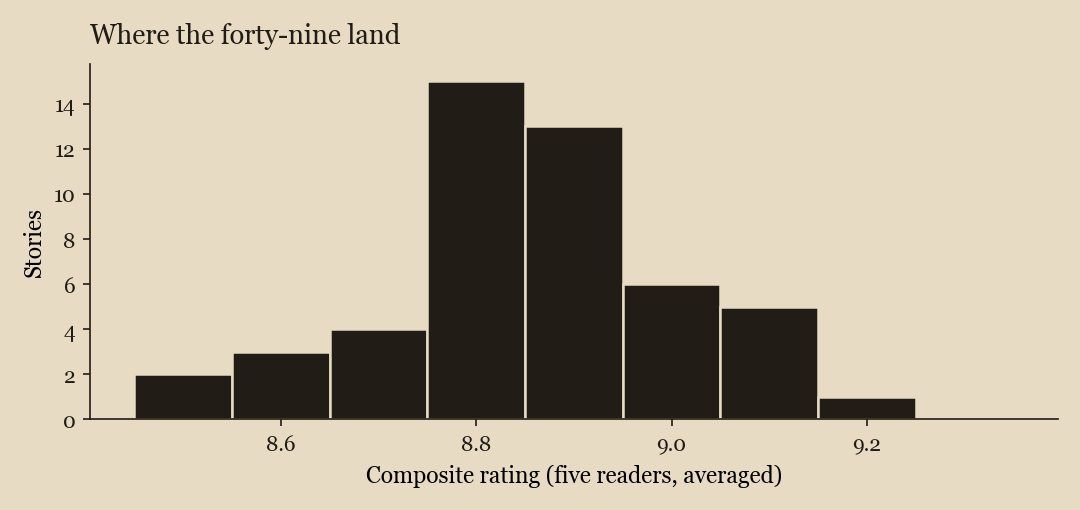
The collection's composite average is 8.85. The top tier (9.0 and above) holds thirteen stories and the hidden paragraph; nothing rates below 8.5. The distance between the highest composite (the hidden paragraph, 9.4) and the lowest (8.5) is nine-tenths of a point — a tight range for a forty-nine-story collection.
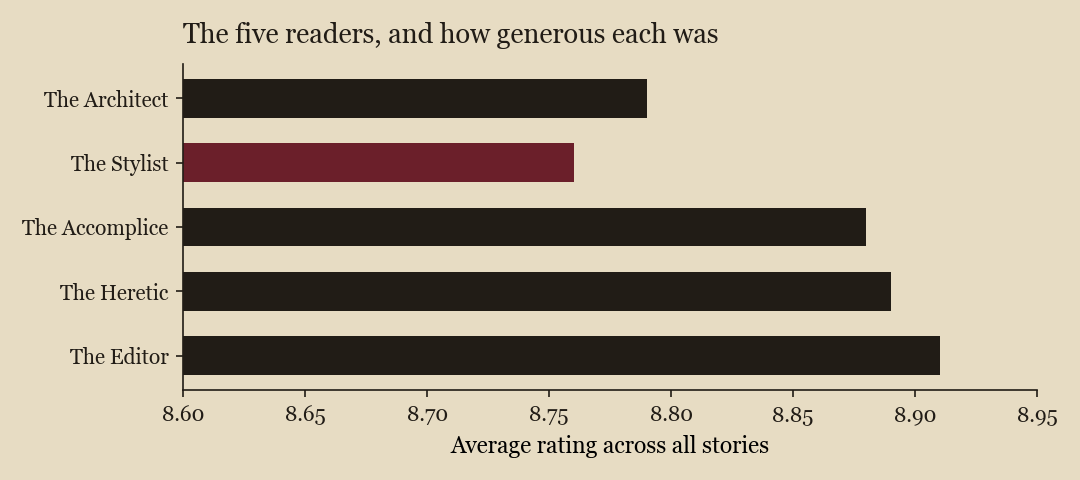
The Heretic, who watches the body, is the most generous reader — the embodiment pass gave him what he wanted. The Stylist, who hears every extra clause as a missed beat, is the least. The interesting thing is not the average but the disagreement: the critics split most about form. The unfinished sentence that is the story's form scores 9.8 from the Accomplice and 8.0 from the Architect. The recursive, perfected library scores 9.8 from the Architect and 8.0 from the Heretic, who asks the only question he ever asks: where is the body? Those splits are evidence the stories are doing specific things, rather than averaging toward competence. A book that pleases every reader equally has usually decided nothing.
The shape of the whole
The forty-nine stories are not a list; they are a constellation. People cluster on one side, places on the other, and the symbolic engine of the book — coffee, temperature, the threshold, the cartography of leaving — sits at the centre. This is a reading map, not a plot chart: it shows how the collection hangs together.

Colophon
This book was written in collaboration with Claude, an AI made by Anthropic. The human directed. The machine generated. The stories belong to both and to neither.
The temperature belongs to the reader.